President Donald Trump’s decision to attack Iran may weaken the U.S. ability to deter great power rivals. But not because the recent U.S.-Iranian memorandum of understanding (MOU) to end the conflict makes the United States look weak. The damage has already been done.
Reactions in the United States largely panned the MOU even as disagreement persisted on the war itself. The MOU consensus points to a damaged U.S. reputation for resolve which can undermine deterrence. Countries, as Thomas Schelling famously argued during the Cold War, should fight to maintain “a reputation for action.” Most post-Cold War U.S. foreign policy practitioners agree. If history is any guide, there will be calls to avoid U.S. concessions and resume strikes if Iran proves obstinate.
The critical issue is not whether a reputation for resolve matters. It is how much it matters relative to other components of deterrence.
To begin answering that, I turned to a question I asked practitioners and professors in 2022-23. The question was included in two surveys by the Teaching, Research, & International Policy (TRIP) project at the College of William and Mary. The first surveyed former U.S. foreign policy officials in national security, trade, and development from November 2, 2022, to January 17, 2023 while the second examined the views of U.S.-based international relations scholars from October 13, 2022, to January 17, 2023.
In each survey I asked, “How would you rank the effectiveness of the following actions in deterring China from pursuing military action against U.S. interests?” Experts ranked five behaviors from most effective (5) to least effective (1). I randomly varied information about the purpose and consequences of standing firm, the essence of reputation for resolve. One group received no additional information. Another was asked the effectiveness of standing firm to enhance America’s reputation for resolve. Finally, a third group assessed the importance of standing firm even it weakens the U.S. capability to deny China rapid success.
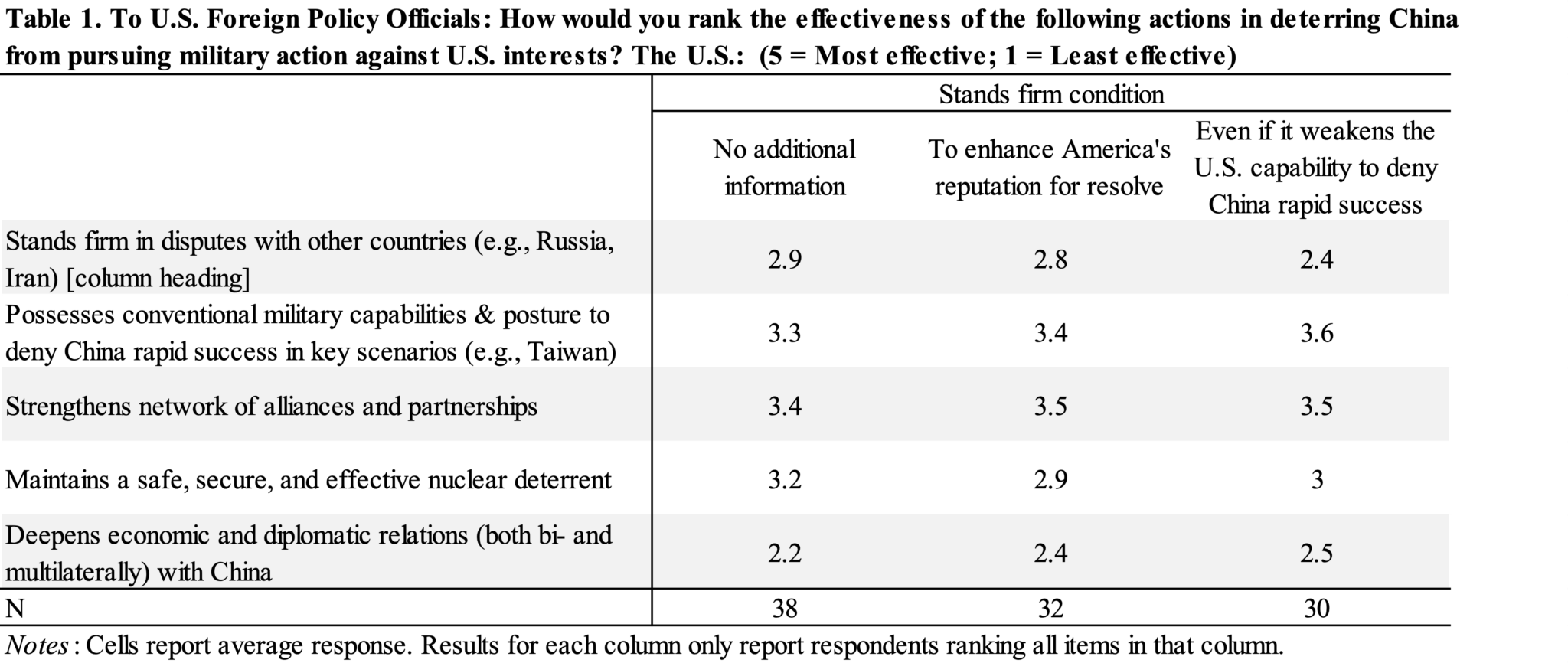
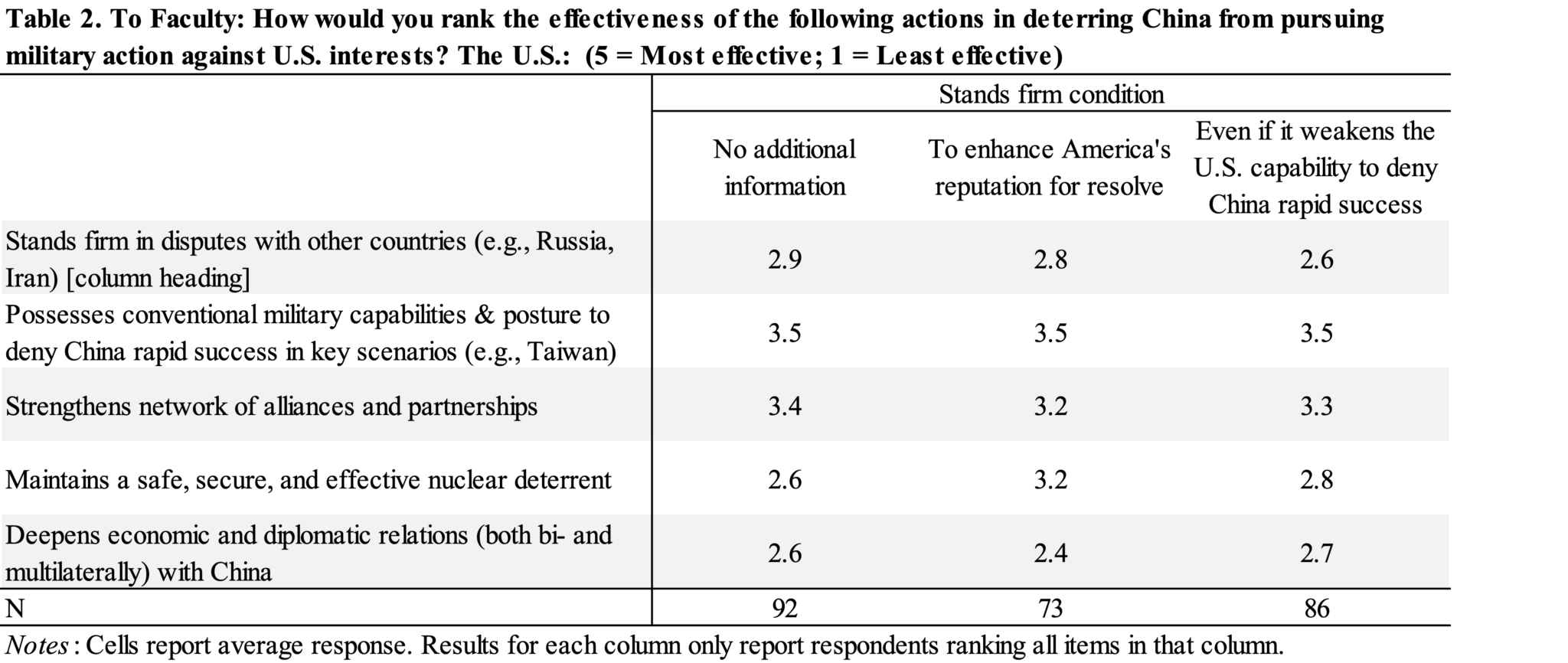
The results in Tables 1 and 2 were strikingly similar. The cells show the average ranking, with five being the most effective. The left-hand column has the response options with the next three columns breaking down which “stands firm” option appeared.
Two things stand out. First, U.S. conventional military capabilities and strengthening alliances and partnerships always received the highest average rankings. Second, the relatively lower rankings for standing firm with other rivals to deter China plummets when doing so weakens U.S. conventional capabilities. The only option to consistently fare worse than standing firm is deepening economic and diplomatic relations with China. Even that differences washes out when the costs to U.S. capabilities are made salient.
The 2026 U.S.-Iran war has strained U.S. conventional capabilities. Reports by the Center for Strategic and International find that U.S. munitions in key categories have depleted to levels that would constrain U.S. operations against China. U.S. capabilities may been impressive but if they’re gone it doesn’t matter.
Allies are upset. As one European diplomat remarked, “The frustration with the current erratic foreign policy swings is growing and increasingly visible.” Germany’s Defense Minister Boris Pistorius said in March that “European partners and Germany highlighted from the beginning that we have not been consulted before. Nobody asked us before. It’s not our war.” These reactions are not surprising. As Iain Henry shows, states want reliable allies rather than allies that blindly support others or fight for resolve. Restraint, Lauren Sukin, Stephen Herzog, and Alexander Lanoszka find, is often more reassuring to friends.
A survey from nearly four years ago may not appear to provide insight today. Views not tied to the current crisis are invaluable, though. Respondents could not factor in their views of the current Trump administration or feel compelled to maintain consistency with what they’ve already said about the U.S.-Iran war.
As the United States goes forward it should avoid making a bad situation worse. The worst thing to do would be to renew the fight just to impress others. The Trump administration will need to demonstrate more patience in diplomacy. Short of direct Iranian attacks the United States should not use military force against Iran. Reducing operations elsewhere can provide additional time to rebuild munitions stockpiles. Throwing money into U.S. defense capabilities is not an answer. That may weaken U.S. power and influence over the long term.
The best option depends on U.S. grand strategy. How determined is the United States to deter great powers? A grand strategy of restraint reduces the challenge because the U.S. would place less emphasis on countering China. If the U.S. maintains a more expansive grand strategy, repairing alliances provides the cost-effective alternative to increasing defense budgets. To begin rebuilding ties, U.S. officials should closely consult friends during negotiations with Iran. Keeping allies updated can allay fears. It might also provide U.S. negotiators more leverage and reduce the costs to the United States to enforce any agreement. U.S. troop withdrawals, which Secretary of Defense Pete Hegseth has hinted atin terms of NATO, should be done by mutual agreement rather than presented to allies as a fait accompli after a unilateral U.S. review.
The Trump administration may not pull back or engage allies. But as attention focuses on U.S.-Iran negotiations the potential costs to deterrence elsewhere should be kept in mind.


0 Comments