There’s a popular story in foreign-policy circles: we’ve entered an unprecedented “age of sanctions.” Countries are cutting each other off economically at a scale never seen before, wielding trade and finance as weapons like never before.
It’s a good story. It’s also, I’d argue, the wrong one.
The world got bigger, not meaner
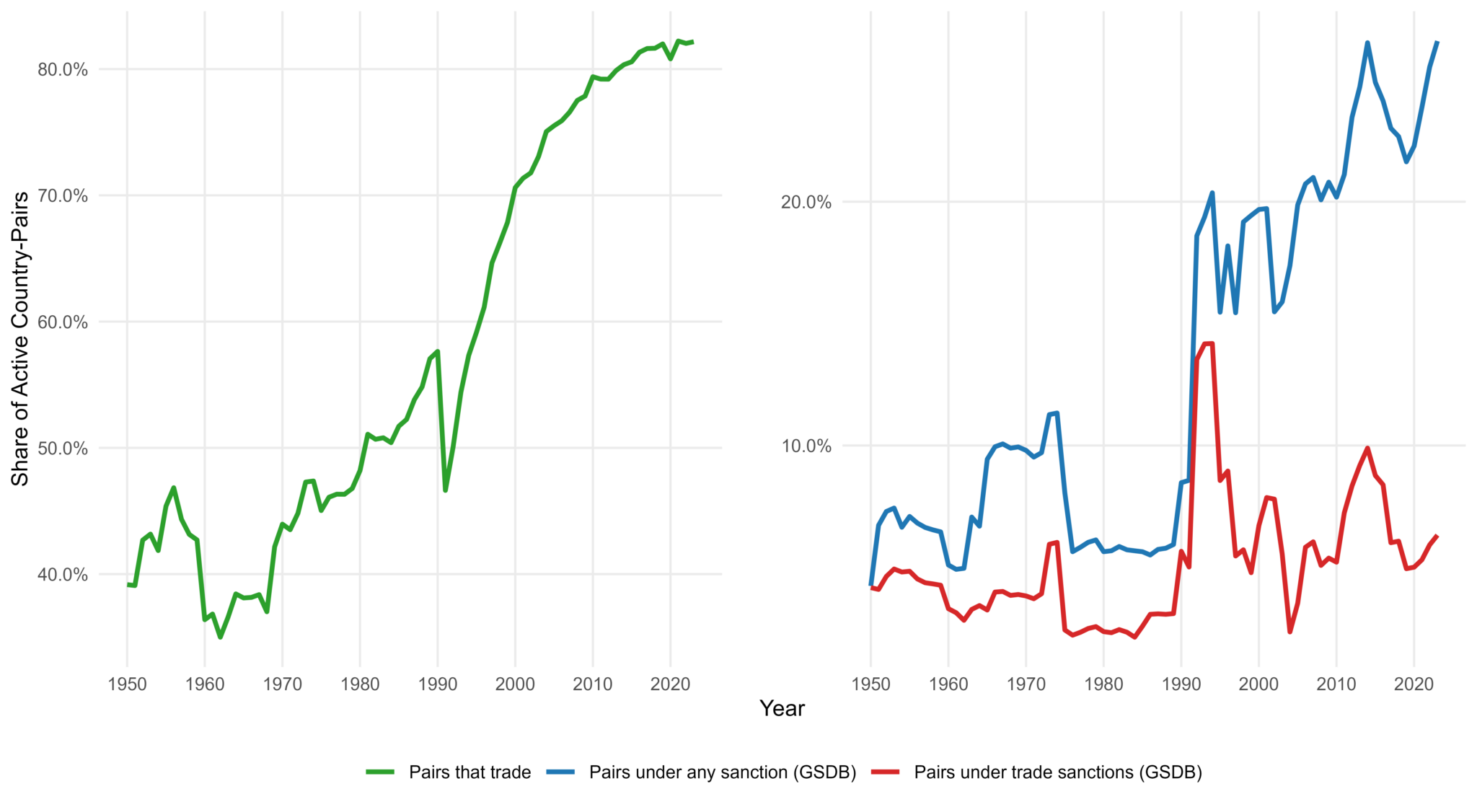
Here’s what the “age of sanctions” story leaves out: the world today is far more economically connected than it used to be. Looking at IMF trade data, back in 1950 only about 40 percent of all possible country pairs actually traded with each other. By 2023, that number had climbed to roughly 82 percent. Almost everyone trades with almost everyone now.
So the real question isn’t “how many countries are being sanctioned?” It’s “how many, given how many more relationships there now are to sanction?” Ask it that way, and the picture changes.
Yes, the share of country pairs hit by sanctions has gone up — there’s a clear jump after the Cold War ended (based on the Global Sanctions Database). About 25 percent of country pairs now face some sanction from one side or the other. More on the different kinds of sanctions below.
But trade sanctions specifically haven’t kept pace. They affected about 5 percent of trading relationships in the mid-twentieth century, just as they do in 2023. Thirty years ago, more than 14 percent of country pairs had at least one side imposing trade sanctions: nearly three times today’s rate.
On trade, we don’t live in an age of sanctions. We live in an age of fewer of them.
Tougher sanctions, or just a more complicated world?
The other half of the “age of sanctions” argument: today’s sanctions aren’t just more common, they’re more severe and layered. Countries don’t just ban one type of exchange anymore — they stack travel bans, financial restrictions, and arms embargoes on top of each other.
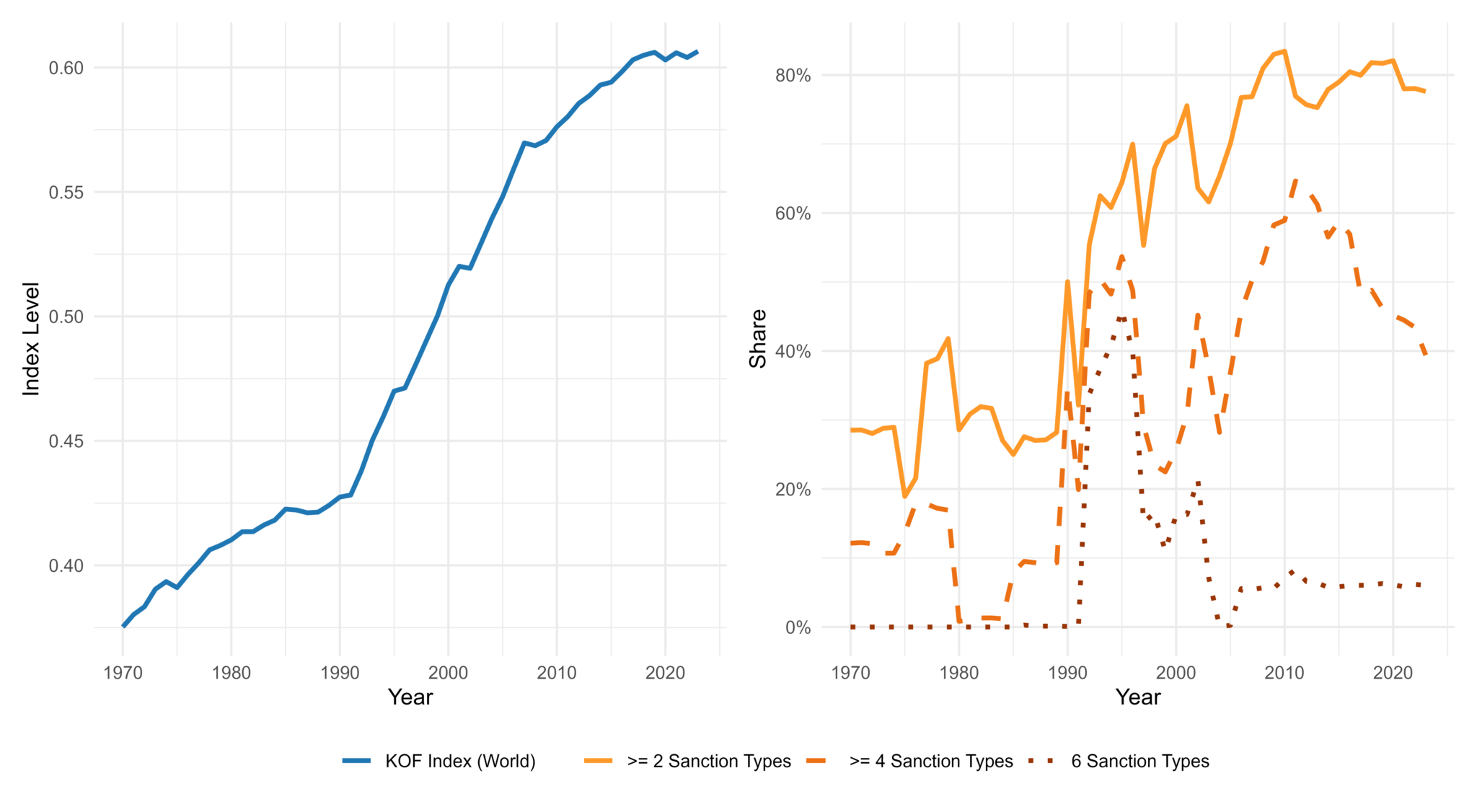
That part checks out. In 1970, about 30 percent of sanctioned pairs faced more than two kinds of sanctions at once. By 2020, more than 80 percent did.
But context matters here too. I compare this trend to the KOF Globalization Index, a standard measure of how economically, socially, and politically linked countries are.
Globalization and sanction complexity move together, almost step by step. Before 1990, when the world was less connected,sanctions tended to be simple — usually just a trade ban. As globalization sped up, sanctions got more complex right alongside it.
That’s not a coincidence. A single trade ban won’t meaningfully restrict a country plugged into a dense web of financial and trade relationships. You need a toolkit that matches the target’s complexity. Sanctions got more sophisticated because the world did.
The real story
Three datasets — on sanctions, on trade, and on globalization — tell a consistent story. Sanctions haven’t grown to cut off more of the global economy than ever before. What’s changed is the environment they operate in.
More countries trade with each other than ever, so there are more relationships available to sanction. Those relationships are more complex than ever, so the tools used to disrupt them are too. Sanctions scaled up because the world did — not because states suddenly discovered some dramatic new weapon.
Call this an “age of sanctions” only if you look at sanctions in a vacuum. Look instead at the scale of interconnectedness we live in today, and the picture changes. We’re living in an age of exchange. The tools of economic coercion just grew to match it.
An earlier version of this article appeared on The Loop.


0 Comments