Raymond Kuo answers 6 (+1) questions about his 2021 book on why the institutional design of alliances changes over time.
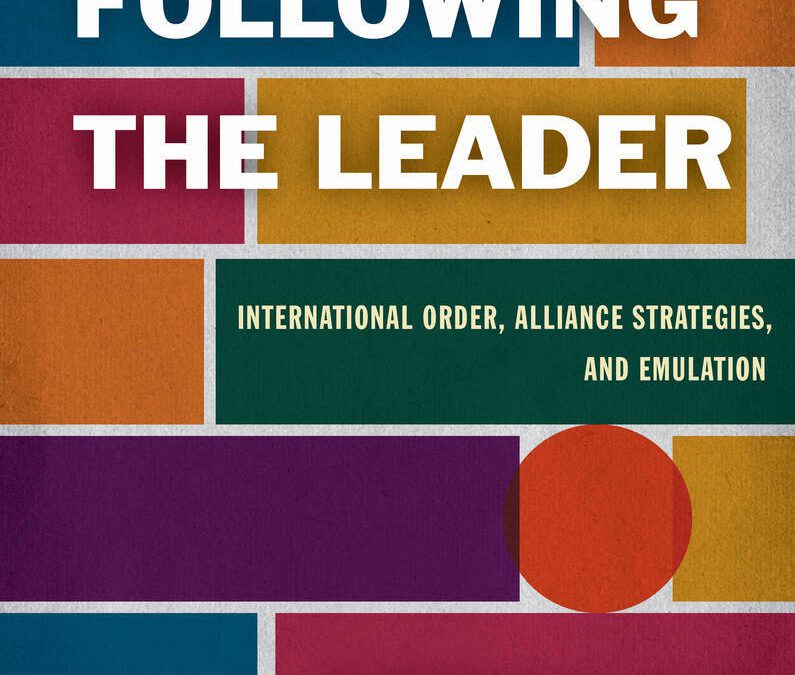
6+1 Questions about Following the Leader: International Order, Alliance Strategies, and Emulation
read more
Raymond Kuo answers 6 (+1) questions about his 2021 book on why the institutional design of alliances changes over time.
Just facts, no opinions. Brutal facts. Today, the President of the United States issued an order that stops our country from admitting this boy as a refugee. This is Omran Daqneesh, a five year old...
I apologize for inflicting this on you all, but I've found that blogging helps me think through ideas and questions—especially given the Duck's readership. So, without further introduction, here are...
The following is a guest post by Dani Nedal, PhD Candidate at Georgetown University and Predoctoral Fellow at Yale University. The surprising political ascent of Donald Trump has prompted two...
In the all Ukraine all the time edition of the Duck, here are some essential reads from this week. Will ad more in a bit. Dan Nexon channeling his inner Henry Kissinger on the Monkey Cage Henry Kissinger channeling his inner Henry Kissinger in the WaPo Joshua Rovner on why Russia's intervention in Ukraine is a blunder What will Germany, one of Russia's main trading partners, do? Obama administration issues new sanctions Crimea prepares for a snap referendum in 10 days on secession Bob Gates tells Republican critics of Obama and Ukraine policy to cool it Hillary unhelpfully compares Putin to...
Russia’s military intervention in Ukraine naturally prompted a lot talk about the limits of international law. Eric Posner noted: “ 1. Russia’s military intervention in Ukraine violates international law. 2. No one is going to do anything about it.” Julian Ku argued: “International law can be, and often is, a very important tool for facilitating international and transnational cooperation. But it is not doing much to resolve to Ukraine crisis, and international lawyers need to admit that.” For Ku, the current crisis supports the claims of Rationalist law-skeptics, international law works...
Today, I fly to give a talk at my alma-mater. As my advisor told me, it’s a victory lap. It feels good – 5 years post PhD, great job, excitement about the future, and my family still intact. However, the thought of going back also has me a little anxious: you see, I don’t have good memories about life in grad school. My university was great, my advisors were fantastic, and my colleagues were super smart. However, the whole experience was wrought with periods of anxiety, stress, and depression. In short, my mental health really sucked in grad school. And, for much of my academic...
Keith Darden points out that if Crimea secedes from Ukraine, electoral outcomes in Ukraine would shift with fewer pro-Russia voters in the political system, and that would be bad for Russia. This is not unique to this case. In any successful secession or irredentist effort (the latter refers to annexing a "lost" territory inhabited by ethnic kin), the boundary moves, changing who votes in the rump state (Ukraine in this case) and who votes in the new state (Crimea if independent, Russia if this is irredentist and Crimea gets annexed). In this case, new voters in Russia would be largely...
This is a guest post by former Duck of Minerva blogger Betcy Jose, Assistant Professor at University of Colorado-Denver and contributor to Al-Jazeera and Foreign Affairs. As the number of posts here suggest, lots of us are watching the fast-moving and somewhat unexpected events in Ukraine with great concern and interest. Others have expertly discussed the reasons for Russian military intervention in Ukraine and how the international community might respond to it (here, here, here, and here). I’d like to contribute a different angle to this complex story by inquiring into Russian narratives...
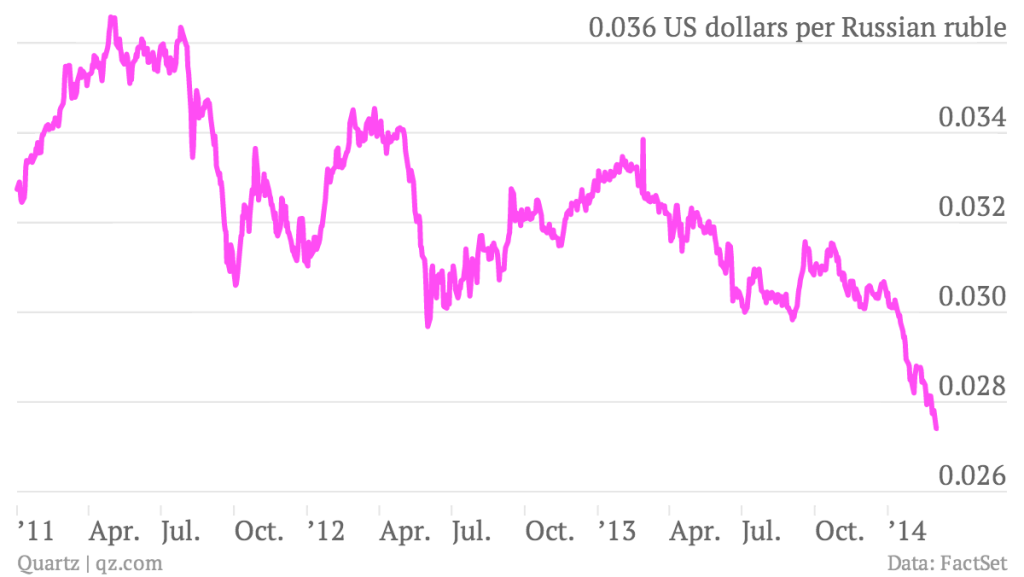
I don't have an answer for this, as I'm not sure how globally integrated Russia is in to the world economy at this juncture or vulnerable given its fossil fuel resources, but I, along with anyone who knows how to buy shares see that the Russian stockmarket declined this morning as has the value of the ruble. I know Russia experienced significant economic crises in the 1990s after the breakup of the Soviet Union that made it dependent on IMF support, but my sense is that the resurgence of the country's petro economy bolstered its international economic position. That said, I wonder if the...
*The following post is written by Ryan Maness and myself. Events are in motion that many thought were past us, part of a bygone era where conventional war still had a prominent place in deciding the course of nations. Having done a great amount of work on Russia’s strategic behavior and use of power (we have a book on the topic under review), we were a bit caught off guard too. Not by the course of events, but that our vision was focused on cyber conflict and thus were distracted from the real world developments. The events in Ukraine fit a recent pattern of Russia’s coercive diplomacy...
[Note: This is a guest post by Sean Kay, Robson Professor of Politics at Ohio Wesleyan University and Mershon Associate at the Mershon Center for International Security Studies at the Ohio State University. He has long-researched and written on NATO policy and worked in the US Department of Defense during the first round of NATO enlargement planning. His forthcoming book is America’s Search for Security: The Triumph of Idealism and the Return of Realism (Rowman and Littlefield, 2014).] Russia’s incursion into Ukraine presents the United States with a dilemma. The cries to “do something” are...