Steve Saideman’s recent Duck piece on international relations scholars’ relative silence on issues of pandemics, and public health more generally, has ruffled feathers[1]and generated a lot of discussion: about marginalization of certain research outlets and methodologies, about the value of interdisciplinary work in a self-identifying-as-such-but-still-not-all-that-interdisciplinary discipline, and about what it means to say “IR as a field has little to say” vs. “individual IR scholars having said quite a bit.”
This all hits pretty close to home. As an IR scholar whose main area of specialization—climate change and conflict—has not received much purchase in mainstream political science and IR outlets, I can sympathize with feeling marginalized. And I’m sure I would bristle at the idea of someone saying “why don’t IR scholars study climate change”, though I’ve always read these pleadings as supportive of a broader platform for work in this area, not a failure to recognize the work that’s already being done. But I think the data are pretty clear: comparatively speaking, public health is not a widely published on topic in mainstream IR journals.
The Teaching, Research, and International Policy (TRIP) team at the College of William & Mary collected comprehensive data on 8,710 articles published between 1980 and 2017 in twelve leading international relations journals: American Journal of Political Science, American Political Science Review, British Journal of Political Science, European Journal of International Relations, International Organization, International Security, International Studies Quarterly, Journal of Conflict Resolution, Journal of Politics, Journal of Peace Research, Security Studies, and World Politics. These twelve emerged at the top of the list in terms of those having the greatest influence on the way IR scholars think about IR. A presumably very large army of students then coded these articles according to a host of attributes, including subject matter.
I pulled the data from the TRIP project website and crunched some basic numbers. Figure 1 shows the distribution of articles according to topic for the twelve coded “top” international relations outlets (note: as articles can have multiple topics, the totals sum to more than 100%). Of the 34 topic areas coded, public health came in last, accounting for just 0.5%. So while it is incorrect to say IR scholars do not study pandemics (and Steve’s modified post and the associated Twitter feed make clear), it is absolutely correct to say that global public health is not a well-covered topic in mainstream IR outlets.
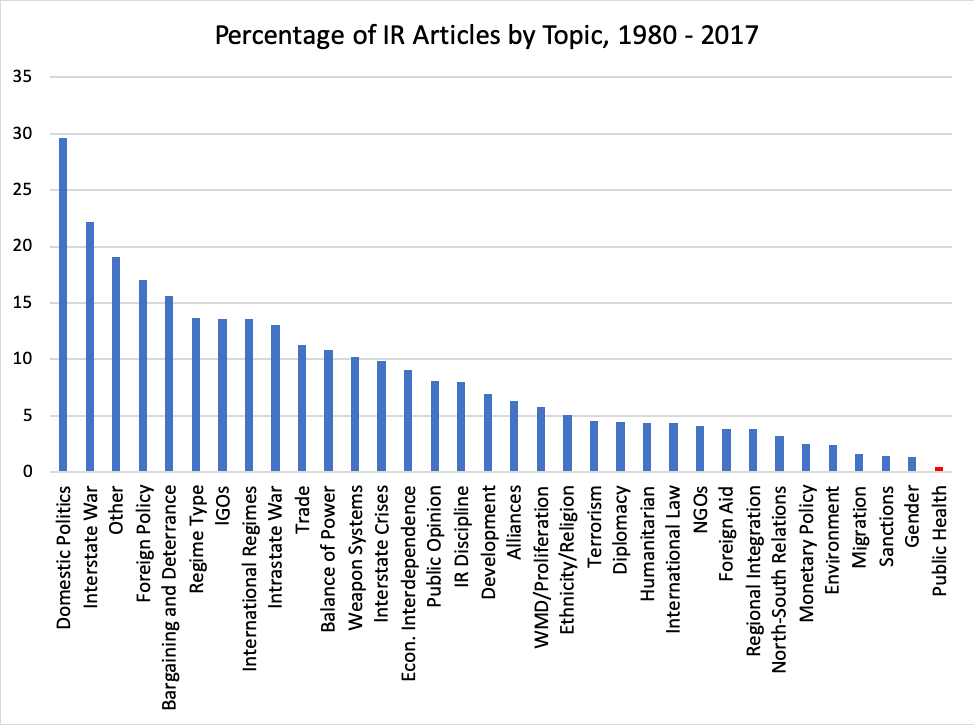
Thinking about these numbers in comparatively, the gaps are considerable. Environmental issues, a set of topics near and dear to yours truly, are fifth to last—and they’ve still received five more times the emphasis that public health has received. Studies addressing the state of the IR discipline and research account for almost 8%. That is, the most influential IR outlets have dedicated over 17 times as much shelf space to research about international relations research as to research about public health. I like navel gazing as much (OK, a lot more than) the next person, but this still seems out of whack.
On this basis, I don’t think it is a stretch to say IR as a discipline does not have much to say about global pandemics specifically and public health more generally. That is not to discount the excellent work that has been done on the subject: Josh Busby and Ethan Kapstein’s and Kim Dionne’s books on the HIV/AIDS epidemic are some exemplary pieces. And there’s plenty of work being done by IR scholars in interdisciplinary (or other disciplinary) outlets on issues related to infectious disease and public health. But there’s little evidence that public health is considered a central topic within the IR canon. And alternative data sources, like Jeff Colgan’s data on what’s taught in IR graduate seminars in top political science departments, do not paint a different picture. Of the 227 “top” articles identified by Colgan, none are explicitly related to public health. If we buy the argument that what we see fit to teach the next generation is what we really value—and it’s a hard argument to dismiss, even if it does not tell the whole story—then public health is clearly not central to our social construction (and propagation) of the IR discipline.
The international dimensions of the pandemic, ranging from the role of IOs and NGOs in coordinating global response to its effects for trade and investment, are myriad. More broadly, the data in figure 1 are pretty clear: three of the most defining challenges we face in the 21stcentury—climate change, migration, and global public health—are among the five least-studied published on topics in mainstream IR scholarship. That needs to change.
[1]I know this is serious business, but this is still the Duck, right?

Cullen Hendrix is Professor and Director of the Sié Chéou-Kang Center for International Security and Diplomacy at the Korbel School of International Studies, University of Denver, and Nonresident Senior Fellow at the Peterson Institute for International Economics. His current projects explore conflict and cooperation around natural resources and the ethics of policy engagement by academic researchers.

0 Comments