The blogosphere peaked somewhere in the mid-2000s, so why would anyone start blogging in 2023?
Academic research can go a long way to shape the debate or can have no effect at all. The problem is that scholars don’t know – and may never know – how their work has been received by policymakers and whether it steered a policy decision in a good or bad direction.
ess than a year after the appearance of "The False Promise of International Institutions," the journal International Security published replies from Robert Keohane and Lisa...
Professor Francois Debrix of Virginia Tech University joins the Hayseed Scholar podcast. Francois grew up in France, attending college there with degrees in Spanish and English, and then...
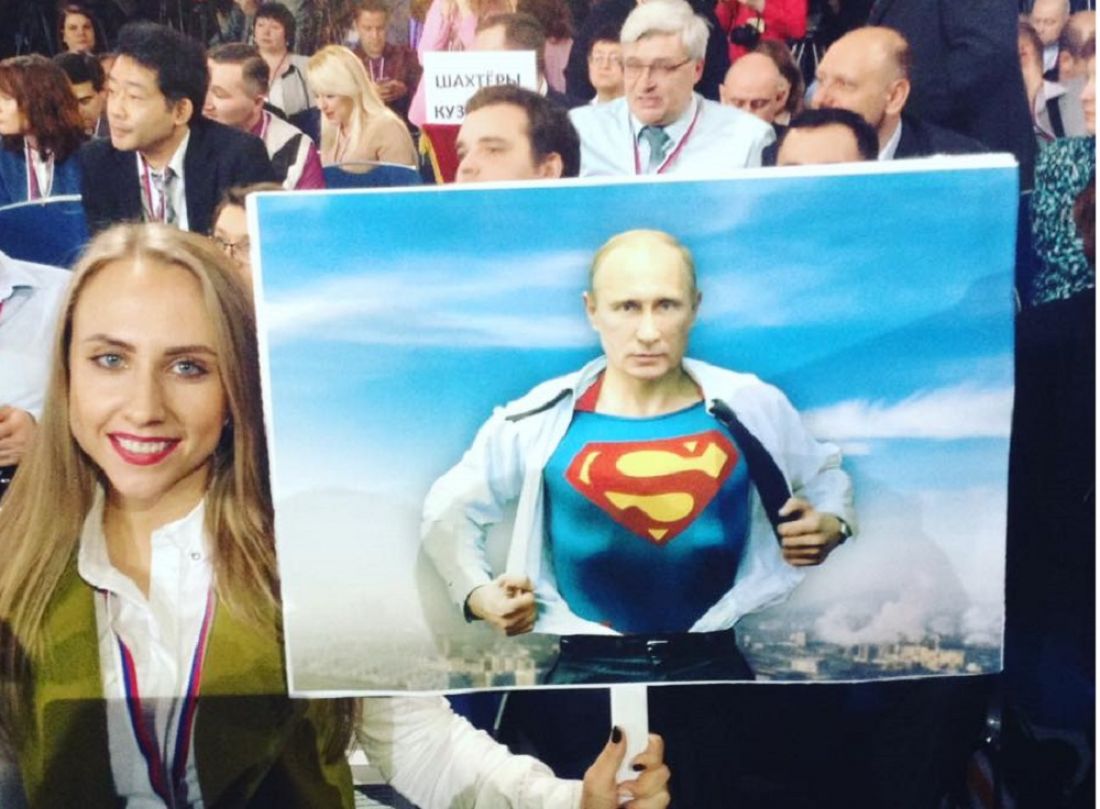
Putin’s annual press conference is a chance for regular citizens to spend 3 hours in a great and rich Russia, where everything is in order and Putin is capable of installing presidents in foreign countries (according to one journalist). In general, the press conference strived to paint a picture of a great power facing some economic problems and who is constantly challenged by other countries (they are probably jealous and/or Russophobic). For me it was also a chance to wonder at Putin’s stamina. He might not be Superman, as one of the posters brought by the journalists stipulated, but his...
The President-Elect has called for expanding the US nuclear arsenal, not just modernizing it (old warheads may not be good warheads). And when asked about whether this might lead to an arms race, he said woot! Who wins arms races? Arms manufacturers and their stockholders Maybe Ken Waltz (who is already dead) Yeah, that's about it. How about who loses? Each country that is involved The taxpayers  Pretty much everyone else. Really? Is it that bad? Yes, it is. Why? There are two possibilities when it comes to a nuclear arms race: either the competition among nuclear powers to build more...
I'll confess that post-November 8th, 2016, I spent a large amount of time in despair and unable to write anything coherent on the topics I am most interested in contributing here at the Duck of Minerva. It was hard for me to imagine what the global order would look like with someone like He Who Shall Not Be Named at the helm of one of the most powerful nations in the world, and not despair. But throughout the next few weeks after the US election, I have seen numerous colleagues in the IR and (more broadly) political science fields engage with society at large, trying to educate the masses on...
Grades are in, reviews submitted, and I'm headed out for the holiday season. Â I hope you are wrapping up the semester and/or enjoying a well-deserved break. Â Please remember to submit your nominations for the 2017 Duckies before the end of the year. And, please remember to attend the The Duckies at ISA:Â Thursday, February 23rd at 7:30 pm. Â The ISA Online Media Caucus (OMC) is very thankful to have the support of Sage in hosting the reception. Send your nominations to onlinemediacaucus@gmail.com. Â Duckies will be awarded in the following categories: Best Blog (Group) in International Studies...
Halfdan Mahler, the Danish physician who served three five-year terms as Director-General of the World Health Organization, died last week in Geneva. Mahler may not be a household name, but he helped to fundamentally transform our collective notions of what global health is and should be. In this moment where WHO is undergoing its own re-examination of its priorities and programs, Mahler’s vision reminds us what could be. He also shows how global health is inextricably linked to international relations and politics. Mahler’s career mirrors the World Health Organization itself in many ways....
It's time. I'm signing off as permanent member of the Duck of Minerva after seven (7!?!) years of blogging. The experience has helped shape me as a professional, writer, and member of the IR and online communities. I began blogging during my first nervous year as an academic and continued through to the current realisation that I'm now a *youthful* mid-career scholar. My posts have covered a very wide range of topics, including ebola, Anthony Weiner's first set of dick picks, women and combat in the US military, and the parallels between police and military racism and brutal tactics. I'm...
This is a guest post by Ariel I. Ahram (@arielahram). Ahram is an associate professor in Virginia Tech’s School of Public and International Affairs and is the author of Proxy Warriors: The Rise and Fall of State Sponsored Militias (Stanford, 2011). A few years ago the possibility that an American president would be complicit as armed supporters attacked members of opposition would have seemed far-fetched. Yet the alliance between president-elect Donald Trump and the so-called ‘alt-right’, a protean alignment of nativists, xenophobes, Christian identarians, and white supremacists, raises this...
It now looks like the candidate who boasted that he knew more than the generals will be a President who appoints them and asks their advice. There has been considerable criticism of this from those concerned about a concentration of civilian power in the hands of former military brass. This is well-reasoned, because a pipeline from the Pentagon to the White House potentially gives too much civilian authority to the military and narrows the lens through which policy is made. We ought to look critically at the institutional consequences of appointing flag officers to cabinet office or key...