Christopher Clary on his new book, which looks at why international rivalry is a hard habit to break.
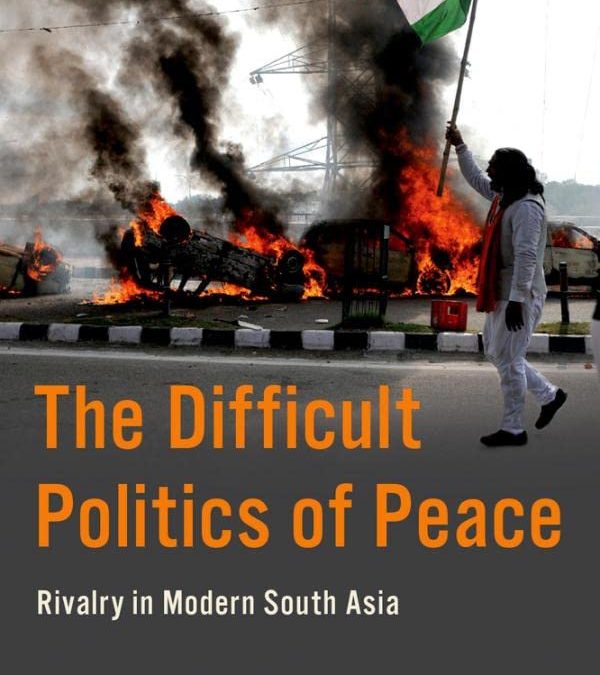
6+1 Questions about The Difficult Policies of Peace: Rivalry in Modern South Asia
read more
Christopher Clary on his new book, which looks at why international rivalry is a hard habit to break.
Editor's note: this post originally appeared on my personal blog. It contains some links to posts that appeared here at the Duck. 1. An interview with Jim Fearon about Ukraine. Lots of good stuff...
Good morning Ducks, here are your links from South Asia... (I am not even going to pretend I know what's going on in the Ukraine, Syria, Somalia, or Venezuela. I'll stick to what I sort of...
Today's thought experiment: A foreign national is killed in your state, igniting emotional protests and a road blockade by members of his community. Your state is almost entirely economically...
The term "Indo-Pacific" has been used since the mid-seventies, mainly to refer to a biological ecosystem. In the last few years, however, "Indo-Pacific" has come to describe a set of interrelated maritime security challenges from the East China Sea to the Arabian Sea -- particularly as India's Navy makes forays into the South China Sea and China seeks to protect its supply routes through the Indian Ocean. But the geopolitics brought into focus by this "45 degree tilt" of the map is not restricted to India and China; it also includes the US, Australia, Japan, and the rising powers of...
I remember once when I was exploring the Indian hill station of Shillong in Meghalaya, I read a random factoid in a guide book which said the town was geographically closer to Hanoi than Delhi. It was not actually very difficult to believe that in the remote states of Northeast India, the gravitational pull begins to shift towards Southeast Asia. I also knew that India's Nicobar Islands were less than 100 miles from the coast of Indonesia. Myanmar and Singapore were once part of British India. Etc., etc... Those random factoids make it seem that regional integration between India and some...
Emperor Bahadur Shah IISource: Wikimedia CommonsThe din of the Great Rebellion of 1857 will continue to echo into our era, marred as it is by ongoing wars and insurgencies in Muslim lands. I believe that a careful study of those events are pertinent for American and European students of global politics today as they attempt to contextualize the challenges to American military might and Western cultural hegemony continuously pulsating onto the global stage from the remote corners of South Asia. A chronicle of 1857 is also useful to understand the fragility of a multicultural society in the...
India appears to be continuing to shift its West Asia policy away from a once budding partnership with Iran, which aimed among other things to stabilize Afghanistan. It is rumored that in late March, the Indian National Security Adviser, Shiv Shanker Menon, delicately delivered a message to the Islamic Republic that India's PM would not be making a state visit later this year (Telegraph [Kolkata] 3/10/11). If the news reports are correct, the diplomatic maneuver comes only a few months after India abandoned the practice of paying for its crude oil imports from Iran through the Tehran...
The visit of the Indian External Affairs Minister, S.M. Krishna, to Afghanistan a few days ago overlapped the Afghan High Peace Council's visit to Pakistan to establish a joint Afghanistan-Pakistan Peace Jirga. Although the overlap of the two events appears to be coincidental, it highlighted the complex trilateral dynamic that must be negotiated.India has now fully backed the reconciliation process with the Taliban in Afghanistan, although India asserted reconciliation could only happen with those who "abjured" violence and broke links to terrorist organizations. In the past, India had...
I attended a forum on the math and science curriculum last night at my kids' school and we had an interesting presentation and discussion on the general state of math and science education in the United States. Several of the parents present at the forum were math and science faculty members from Smith College and from UMass. One prominent theme was the lament that the US was falling behind China and India in the math and sciences.One of the parents referred me to an article and data published last summer in Money magazine. A key finding:As math and science talent accumulates abroad,...
Since the Nineties, Indian elites have been increasingly described as "pro-American." While attending a mini-conference of a segment of India's foreign policy and security elite in New Delhi last week, I kept noting how widespread the "pro-American" sentiment seemed to be. In fact, I heard one of the intellectuals argue that India's rise would naturally be assisted by other secular, pluralistic, constitutional democracies and resisted by states which adhered to the principle of harmony. Such a statement would have been unthinkable in the recent past (although it may still be terribly naive)....
I am in New Delhi doing research on elite perceptions of India's strategy in Afghanistan. I just thought I would share a few quick observations from conversations with Indian security experts... One of the greatest benefits of coming all the way out here is to help situate research questions within a broader political discourse. Here is what I have noted so far:First, one quickly realizes that the voices which are most accessible to us in the US are often the ones which are the flashiest and most aggressive in the local context. However, these personalities are not necessarily the most...