In July 2025, the UK government designated Palestine Action as a proscribed terrorist under the Terrorism Act 2000, making it a criminal offence to be a member of, or provide support to, the group. The decision followed...

In 2018 and 2019, two Boeing 737 MAX planes crashed, killing 346 people hailing from 36 different countries across the globe. Now, some of the families who lost loved ones are challenging in U.S....
In an attempt to distract myself from the thought that today my small university town will be overrun by 900 frat boys who went to Northern Italy on a skiing vacation despite the Dutch government’s...
The following is a guest post by Dr. Jillienne Haglund, Assistant Professor of Political Science at the University of Kentucky. Dr. Haglund is a contributor to a forthcoming special issue in...
Last week I was able to host and facilitate a multi-stakeholder meeting of governments, industry and academia to discuss the notions of “meaningful human control” and “appropriate human judgment” as they pertain to the development, deployment and use of autonomous weapons systems (AWS). These two concepts presently dominate discussion over whether to regulate or ban AWS, but neither concept is fully endorsed internationally, despite work from governments, academia and NGOs. On one side many prefer the notion of “control,” and on the other “judgment.” Yet what has become apparent from many...
In 1941 Heinrich Himmler, one of the most notorious war criminals and mass murders, was faced with an unexpected problem: he could not keep using SS soldiers to murder the Jewish population because the SS soldiers were breaking psychologically. As August Becker, a member of the Nazi gas-vans, recalls, “Himmler wanted to deploy people who had become available as a result of the suspension of the euthanasia programme, and who, like me, were specialists in extermination by gassing, for the large-scale gassing operations in the East which were just beginning. The reason for this was that the...
This past week I was invited to speak as an expert at the United Nations Informal Meeting of Experts under the auspices of the Convention on Certain Conventional Weapons (CCW). The CCW’s purpose is to limit or prohibit certain conventional weapons that are excessively injurious or have indiscriminate effects. The Convention has five additional protocols banning particular weapons, such as blinding lasers and cluster bombs. Last week’s meetings was focused on whether the member states ought to consider a possible sixth additional protocol on lethal autonomous weapons or “killer robots.” My...
We hear every day that technology is changing rapidly, and that we are at risk of others violating our rights through digital means. We hear about cyber attacks that steal data, such as credit card numbers, social security numbers, names, incomes, or addresses. We hear about attacks that steal intellectual property, from movies to plans for the F-35 Joint Strike Fighter. Indeed, we face a continual onslaught from not only the cyber criminals, but from the media as well. One of the lesser-reported issues in the US, however, has been a different discussion about data and rights protection:...
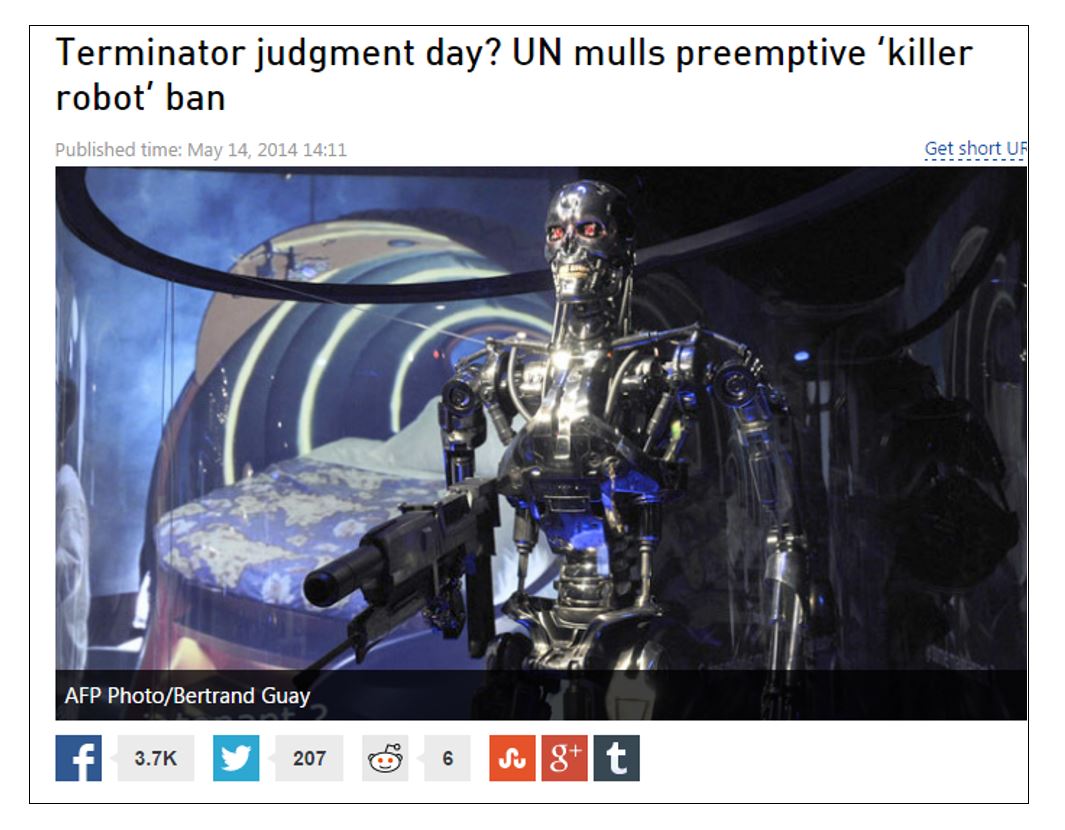
In May of 2014, the United Nations Convention on Conventional Weapons (CCW) first considered the issue of banning lethal autonomous weapons. Before the start of the informal expert meetings, Article 36 circulated a memorandum on the concept of “meaningful human control.” The document attempted to frame the discussion around the varying degrees of control over increasingly automated (and potentially autonomous) weapons systems in contemporary combat. In particular, Article 36 posed the question as one about the appropriate balance of control over a weapons system that can operate...
On November 3, Britain’s head of the Government Communications Headquarters (GCHQ) published an opinion piece in the Financial Times, noting that technology companies, such as Twitter, Facebook, WhatsApp, (and implying Google and Apple), ought to comply with governments to a greater extent to combat terrorism. When tech companies further encrypt their devices or software, such as what Apple has recently released with the iPhone 6, or what WhatsApp has accomplished with its software, GCHQ chief Hannigan argues that this is tantamount to aiding and abetting terrorists. GCHQ is the sister...
In the thirteenth century, before the rise of the “modern” state, private enforcement mechanisms reigned supreme. In fact, because monarchs of the time had difficulties enforcing laws within their jurisdictions, the practice of private individuals enforcing their rights was so widespread that for the sovereign to be able to “reign supreme” while his subjects simultaneously acted as judge, jury and executioner, the practice of issuing “letters of marque and reprisal” arose. Merchants traveling from town to town or even on the high seas often became the victims of pirates, brigands and...
In a phone call today with a friend working on issues pertaining to the Responsibility to Protect (R2P), an interesting question arose. In particular, what types of conflict are going on with the fight against ISIS? My friend wanted to draw attention to the R2P aspects of the crisis, and whether the “intervention” on the side of the US was just according to these standards. While this is certainly an interesting question, I think it points us in the direction of a larger set of questions regarding the nature of the conflict itself. That is, what are the existing laws with which we ought to...