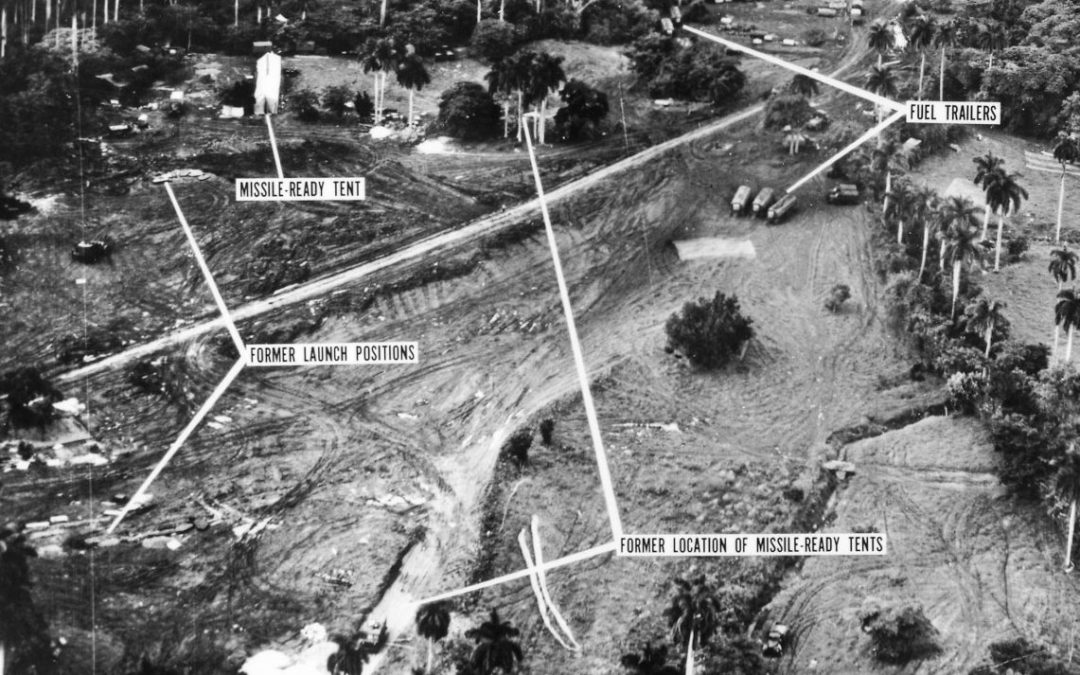
This post is the first in a four part symposium on the Cuban Missile Crisis, one of the the most studied cases of IR. With the release of documents in recent decades, historical revisions have challenged the received wisdom informed by mainstream...
Yesterday, a student asked me about the recent news reports indicating that Iraq did, in fact, have "weapons of mass destruction" back in 2002 and 2003 when the U.S. was attempting to justify a...
This was another busy week in global politics and I'm going to highlight some of the best tweets in my Twitter feed. Before starting, however, I will acknowledge that this post is late. I believe my...
The stability-instability paradox is a concept from nuclear deterrence land: that if two sides both have nuclear weapons that can survive a first strike, it might just create deterrence at the...
Erik Voeten has a nice piece up about recent research on the benefits of nuclear superiority. Does nuclear superiority provide an advantage to states engaged in crisis bargaining? In the most recent issue of International Organization (ungated version) my colleague Matthew Kroenig argues that in a crisis between two nuclear powers, the state that enjoys a nuclear advantage is willing to run more risk than its opponent. This gives the nuclear superior state greater “effective resolve,” meaning that the other state is less likely to think that the state with nuclear superiority will back down....
My daughter is very anxious that Mitt Romney might win the election. Before that she was worried about the European monetary crisis and what might happen if Greece defaults. This suggest that the problem is less one of our partisanship than of growing up the kid of international-affairs specialists who listen to the news during the morning commute. Regardless, her anxiety suggested it was time for "the talk." We'd already had the "Republicans are good people" talk. It went something like this: "your grandfather is a Republican, and he's a wonderful human being. We just disagree on what's...
In 1963, JFK predicted that there would be as many 25 nuclear powers by the 1970s. Yet here we are, some 70 years later, and the number of states believed to possess nuclear weapons has grown from 4 to 9. Why haven't more states joined the club? A variety of factors are undoubtedly at work (see this piece by Gartzke and Joon for a good attempt at bring systematic evidence to bear on this question). In this post, I am going to discuss one in particular: what William Spaniel refers to as "butter-for-bombs" agreements, wherein one state makes concessions to another in attempt to dissuade them...
At multilateral "Meetings of States Parties (MSP)" conferences, delegates are there to review progress made since the establishment of some treaty standard or another - in this case the Convention on Cluster Munitions (CMC) three years ago (3). In the plenaries, therefore, diplomats praise one another's efforts to implement the treaty with fancy prepared speeches, congratulate their hosts for a beautifully organized event, call on non-signatories to join the treaty, and generally take stock of how to strengthen adherence to the rules. But just like at academic conferences, all the really...
Robert Golan-Viella reflects on a tectonic shift in partisan foreign-policy debate, i.e., the fact that the Democrats have the upper hand. He chalks this up to campaign politics: the key to a Republican victory runs through the economy. I agree that there are "strong critiques" of Obama foreign policy and that "leading Republicans aren't making them." But I don't think this is "politically smart," insofar as leading Republicans are making attacks on Obama foreign policy--just not very good ones.As Blake Hounshell noted on twitter of the latest broadside from the Romney campaign: I expect...
Jennifer Lind has a good piece up on Foreign Affairs this week on why NK seems to regularly get away with with hijinks like last week’s rocket test (which directly contravenes UN Resolution 1874). She notes, correctly, that NK has been pulling unanswered, wild stunts like this for years – shootouts in the Yellow Sea, nuclear tests, kidnappings, etc. Further, the US particularly tends to hit back when hit. Indeed, looking at the GWoT, America’s problem is over-reaction rather than passivity. If we look at the Israelis, it’s similar. They have a well-established reputation of hitting back,...
This week is the big nuclear security summit in Seoul, with something like 60 attending countries and over 40 heads of state or government. A friend from a Korean expat magazine here in town asked me for a brief write-up. Here are the issues as I see them from Korean IR and the local media. For full-blown think-tankery on the summit, try here. 1. Obama’s personal commitment to de-nuclearization: I can’t think of any president since Reagan who seems as personally offended by nuclear weapons as Obama. Back in the day, Reagan watched ‘The Day After,’ ‘Wargames’ and other nuclear war movies and...
My colleague, Matt Kroenig, has generated a ton of buzz (and not a little vitriol) for his Foreign Affairs piece in which he advocates imminent US military action against Iran. What's probably less well known, however, is that Matt and Mike Weintraub, a graduate student at Georgetown, have a working paper in which, as they write:We argue that nuclear superiority, by increasing the expected costs of conflict, improves a state’s ability to deter potential adversaries. We then show that states that enjoy nuclear superiority over their opponents are less likely to be the targets of militarized...