Does Whataboutism work? A new article has answers.
6+1 Questions about “The Diplomacy of Whataboutism”
read more
Does Whataboutism work? A new article has answers.

This is the fifth in our series of remembrances on the late Susan Sell. There was a terrific gathering at ISA 2024 where friends and colleagues gathered to remember Susan's wit, her contributions to...

Professor Sebastian Kaempf of the University of Queensland joins the Hayseed Scholar podcast this week. Seb grew up in Germany, with the fall of the Berlin Wall happening when he was entering his...
THe short-term contributions of the Special Issue have been worthwhile, but there remains a continued concern and challenge that with greater attention paid to race and imperialism in IR, these issues will become co-opted into the game of academic production, sanitised as intellectual curiosities, instead of being treated as matters of life and death that need to be opposed practically and not just on paper.
International institutional policy, shaped by a globally entrenched explanatory framework of development and underdevelopment, perpetuates the suppression of knowledge production aimed at challenging social, economic, and political injustices by elites across the global South
Intra-elite, state-centric society is a strategic front, and ought to be defended and put to use in the continued development of a global and decolonial turn in IR.
The special issue’s concerns could easily be a passing ‘fad’ as the forces of the status quo bide their time. A focal point on race, necessary as it is, could elide class and material factors’ influence on world politics.
There is no shortage of knowledge produced in various traditions and diverse scholarly communities. There is no lack of theoretical traditions and political thought that come from non-Euro-American and mainstream canons. There is also no shortage in theoretical concepts and approaches to global politics that are not produced in Anglophone spaces. Rather, there is still in mainstream IR a major problem of literacy to access, integrate, and dialogue with this wealth of IR scholarship produced in and from the margins
Even when Latin Americans are allowed to speak, IR scholars and practitioners do not listen to them due to the language in which they produce knowledge, epistemic violence and access barriers.
Decolonial methods, and the bringing of attention to race in knowledge production is necessarily historical. It demands a close re-reading of archives, forgotten texts, and sometimes “canonical” works. As a result, through this special issue and the wider work the authors build upon, we now have a very different understanding of the historical entanglements of race and international affairs knowledge.
Now that the myth of “theory-practice gap” has been largely refuted what role might IR and journals like International Affairs play in crafting a “reparative praxis”?
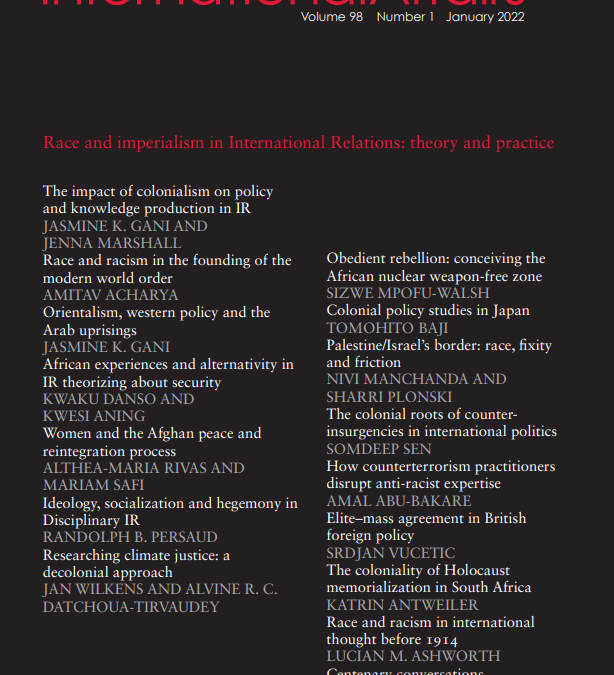
The International Affairs Centenary Special Issue on “Race and Imperialism in International Relations: Theory and Practice” was published two years ago in the aftermath of the global Black Lives Matter movement; it marked an atypical period of introspection by many scholars, departments, and journals of International Relations on the general paucity of attention given to matters of race and imperialism in IR research and teaching.