Much of the discourse about the recent UK local elections had to do with the decline of Labour under Keir Starmer and the worrisome rise of the far-right Reform Party. This is obviously important, but the outcome in Scotland’s parliamentary elections may have just as much of an impact on the future of UK politics.
Devolution and Scotland
This is a different topic than what I normally write about, although I have a few pieces on Scottish politics. My interest came from my sabbatical a few years ago, which I spent at the University of Edinburgh’s Institute for Advanced Studies in the Humanities. Don’t worry Scots, I’m not going to claim to be a descendant of Robert the Bruce. I just found the country wonderful, and its politics fascinating.
While Scotland has been part of the UK for a few centuries, it has always distinguished itself from the dominant England. This was codified in 1999 with the creation of the Scottish Parliament and the devolution of some powers to the parliament.
The move did not satisfy all in Scotland, however, and the Scottish National Party (SNP)—the dominant party since devolution—pushed for an independent referendum in 2014. That failed, although the SNP continues to see independence as a possibility, especially when the pro-EU Scotland was forced to leave that body due to Brexit.
While the Scottish parliament does not have full control over their policies, devolution has granted them enough power to craft their own unique governance distinct from whatever is happening in Westminster. And this is why the results of the recent elections are so important. Under the SNP Scotland has pushed a nationalist agenda distinct from the far-right populism seen in other areas. It has fused nationalist pride with a progressive spirit that could be a model elsewhere. If it survives.
The election results
As occurred in the rest of Britain, Reform gained at the expense of Labor and the Conservatives. Meanwhile, the SNP kept the largest number of seats, although not enough for a majority. And the progressive Greens and Lib Dems gained seats.
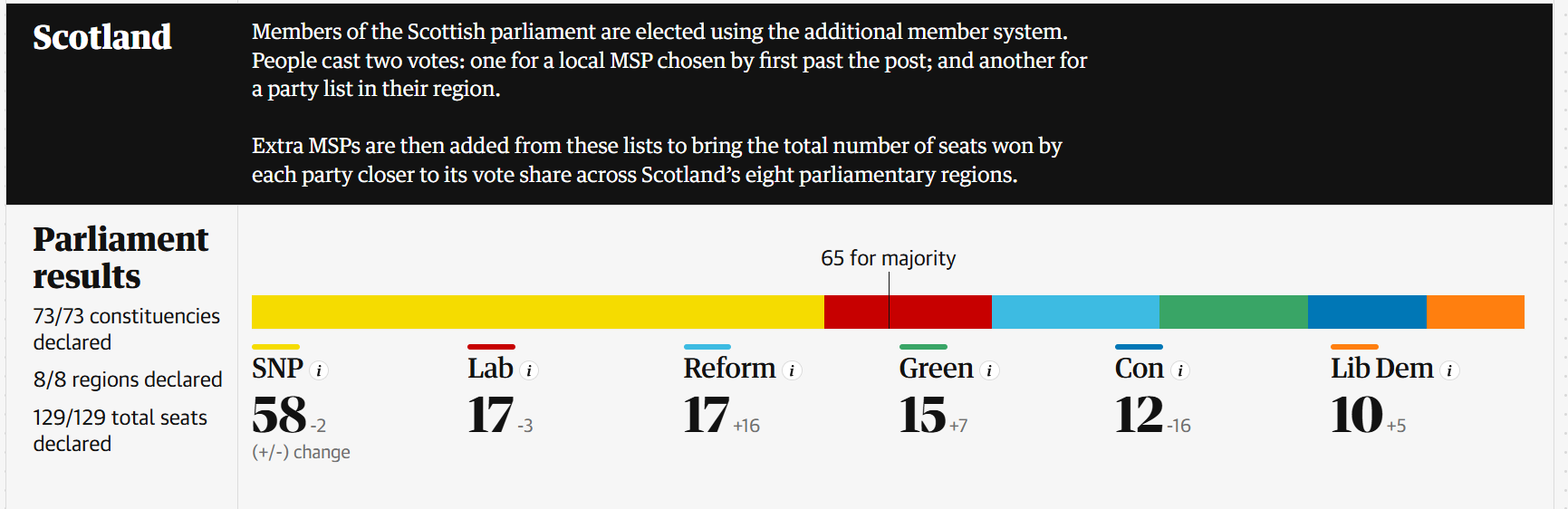
This is a more complicated picture than the “Labour loses to Reform” one seen in England. Reform gained, but so did more progressive parties. What does this mean?
The SNP has fused nationalist pride with a progressive spirit that could be a model elsewhere. If it survives.
UK election observers agree this represents a shake-up of Scottish politics. The SNP remains weak after a drubbing in the 2024 elections, when Labour surged. It will have to form a coalition government, although its last attempt—with the Greens—fell apart.
What happened?
Conservatives argue Reform split the right-leaning anti-independence vote. And discussions on the UKpolitics subreddit suggest some of Reform’s gains came from SNP voters who switched to Labour last time. It’s telling that Reform’s gains came from regional lists, rather than constituency votes (see the explainer in the graphic above). I’m happy to be corrected, but to me that suggests voters tended to be happy with their local candidate but wanted to express discontent with the overall state of the country.
And that certainly seems to be the case. Voters in Scotland seem frustrated with the SNP over public service issues. The resignation of the previous First Minister, Humza Yousef, over the coalition agreement with the Greens and the political scandal over Nicola Sturgeon and SNP finances couldn’t have helped.
But again, this wasn’t a case of Reform pushing out all progressive voices. The Lib Dems gained at the expense of the SNP, and the Greens gained seats throughout the country. They are all rather similar in terms of platforms, although the Lib Dems haven’t supported independence. And the Greens were very critical of the SNP for not doing enough to protest Israel, even though the SNP supported a Greens-led motion to boycott Israel.
What does this say about Scottish progressivism?
This is the real question.
One answer is that the SNP’s project has failed. It has not secured independence—and Westminster has blocked another referendum—and its progressive policies have not improved Scotland. So voters are turning elsewhere. The fact that so many embraced Reform—which is, at its base, an English nationalist party—suggests anger at the SNP’s platform.
The SNP’s progressive nationalism is a wager that this approach will bring the best results for the Scottish people. Sniping among the left, and a failure to ensure good governance, could undermine that promise.
Another is that the Reform gain is mainly due to Labour and Conservative weakness. The Greens’ gains, in turn, suggest progressivism is still strong in Scotland, even if voters are tiring of the SNP.
The third option is that this suggests broader dissatisfaction with the UK. The SNP is still the strongest party, despite all its missteps and scandals. That says something. And there were pro-independence gains in Wales and Northern Ireland as well. This suggests Britain’s struggles since Brexit are threatening the entire union.
I think the second option is the most accurate. The Reform gain seems to be a protest vote, albeit a worrisome one. The Greens’ rise is hard to question. But it should prompt concerns in Scotland over the viability of their unique progressive nationalism. It is a wager, that this approach will bring the best results for the Scottish people. Sniping among the left, and a failure to ensure good governance, could undermine that promise.


0 Comments