Reacting to a recent event on the study of religion, conflict and peace
Instead of Dry January, I'm going review free for January after having nearly 80 review requests last year. My New Year's resolution was to have a healthier relationships with reviewing, which had...
My New Year's resolution for 2026 is to somehow make peace with reviewing for journals. Something is amiss, at least for me, but perhaps it reveals a larger problem related to journal and book...
I started this post sort of confessionally. It's been a while since I wrote on the blog. I had started one earlier this year on the destruction of USAID and PEPFAR but redirected my energy into...
I wrote a chapter for a newly published edited volume, Teaching Political Science and International Relations for Early Career Instructors. The volume itself, capably edited by Michael P.A. Murphy and Misbah Hyder, is indeed concerned primarily with providing guidance for “Early Career Instructors” (ECIs) ranging from Ph.D. students to tenure-track faculty members. I was asked to write about mentorship for ECIs—given the challenges one faces in the classroom, how can mentors support ECIs? My chapter, “Teaching in Context,” argues against the idea that there is one “right” way to teach any...
A lot of ink has been spilled and bytes spent on the reflections over Trump's failed assassination this past weekend. I won't pretend I know better, although as a regular academic that's kind of my job and an occupational hazard. But as soon as my co-author texted me about the events in Butler, PA, I responded that a carnival usually ends with the execution of the mock-king. Once more details started to come in, especially about the identity of the shooter, it made even more "sense" (if any sense can be found in an act of violence). Let me explain. 6 years ago, I posted on the Duck...
This is the fifth in our series of remembrances on the late Susan Sell. There was a terrific gathering at ISA 2024 where friends and colleagues gathered to remember Susan's wit, her contributions to the discipline, and her career-long efforts to challenge orthodox thinking and staid hierarchies. I took my first Ph.D. class with Susan Sell at GW. She didn’t know it, but I was a “first generation” student, being the first one in my extended family to complete a college degree, let alone a Ph.D. From my very first day in her class, Susan was the exact opposite of those horrible...
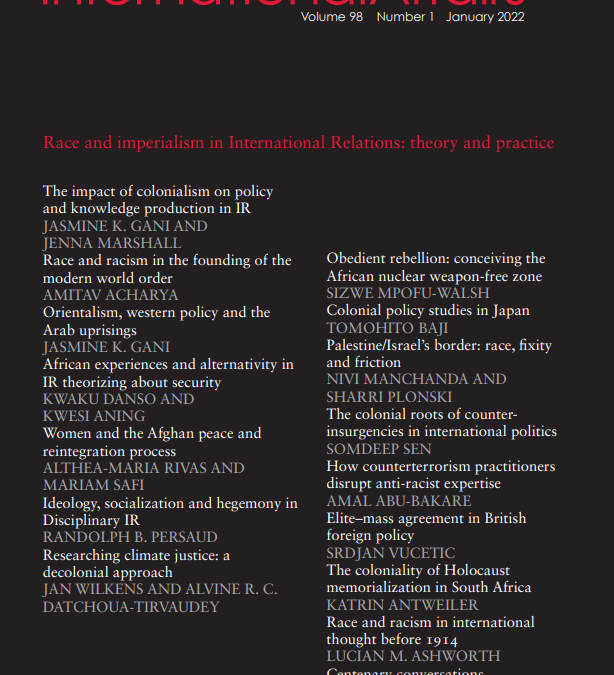
THe short-term contributions of the Special Issue have been worthwhile, but there remains a continued concern and challenge that with greater attention paid to race and imperialism in IR, these issues will become co-opted into the game of academic production, sanitised as intellectual curiosities, instead of being treated as matters of life and death that need to be opposed practically and not just on paper.
International institutional policy, shaped by a globally entrenched explanatory framework of development and underdevelopment, perpetuates the suppression of knowledge production aimed at challenging social, economic, and political injustices by elites across the global South
Intra-elite, state-centric society is a strategic front, and ought to be defended and put to use in the continued development of a global and decolonial turn in IR.
The special issue’s concerns could easily be a passing ‘fad’ as the forces of the status quo bide their time. A focal point on race, necessary as it is, could elide class and material factors’ influence on world politics.
There is no shortage of knowledge produced in various traditions and diverse scholarly communities. There is no lack of theoretical traditions and political thought that come from non-Euro-American and mainstream canons. There is also no shortage in theoretical concepts and approaches to global politics that are not produced in Anglophone spaces. Rather, there is still in mainstream IR a major problem of literacy to access, integrate, and dialogue with this wealth of IR scholarship produced in and from the margins