Academic debates about NATO-Russian relations are deeply entangled with policy preferences.
Syria’s civil-proxy war is on the cusp of turning into an all-out regional war, with negative repercussions for all involved in the conflict. The humanitarian disaster is at its most acute to date,...
The following is a guest post by Dan Reiter, the Samuel Dobbs Candler Professor of Political Science at Emory University. Dr. Cullen Hendrix’s recent Duck of Minerva post on citation counts sparked...
A short time from now, at a conference venue far, far away (at least from Amherst, MA...): The papers on this panel examine the relationship between the Star Wars franchise and socio-political...
After last week's diplomatic overtures on Syria, we've entered a period of relative calm and back to our mixed bag of stories of interest. NPR is running a fabulous series on Brazil in the lead up to the World Cup, which is also timely since the Brazilian president cancelled her plans to visit the United States as a result of U.S. spying on her and other Brazilians, a revelation that came out of the Snowden affair. In other news, I'm going to link to stories on Chinese extraordinary measures to address pollution, how much energy electricity your average refrigerator uses, Nathan Jensen's...
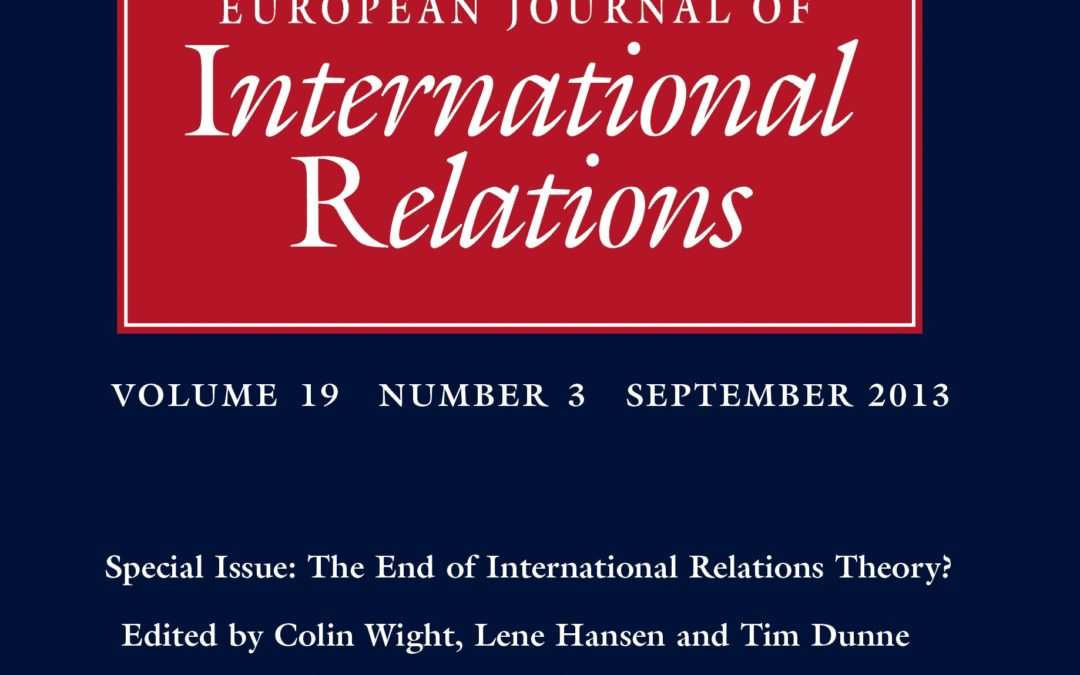
[Editor's Note: This is a guest post by Guzman Castro of the University of Pennsylvania. This post refers to an article and post in the European Journal of International Relations-Duck of Minerva symposium on "The End of International Relations Theory?"by Christian Reus-Smit and the corresponding post by Milja Kurki.] Christian Reus-Smit's and Milja Kurki's interventions in the EJIR symposium are part of a laudable mission to defend meta-theory from the “activists for our emancipation from meta-theory.” The “activists” in this case turn out to be the duo of Sil and Katzenstein in their...
Having been invited to offer an ‘overall response’ to this special issue, I decided to take a look at how the contributors deal with the editors’ claim that we are witnessing the end of ‘IR Theory’. But let me preface this with an observation. The EJIR editors’ decision to compile this special issue, taken at the 2011 ISA conference in Montreal, occurred parallel to the creation of the ISA Theory Section (in which I was closely involved). While this was not a consciously coordinated effort, neither was it a coincidence. Both initiatives were motivated by a similar concern, namely a...
We have all quit from time to time. Choosing when to quit and move on is tough proposition, especially for researchers. I never really thought much about the issue and how it relates to our work until Dave Chappelle brought it home for me recently. I saw his set on the Funny or Die tour during APSA weekend in Chicago. I just had to go; I can only take so many nerdy conversations. Of course Dave Chappelle is famous for quitting his show. Many say he walked out on $50 million dollars plus a litany of other accusations. He maintains he just had to get away. That $50 million was never on the...
Brief but important interview with Andrew Gelman. Here's one thing regarding "great applied work": Ask yourself the question: What makes a statistician look like a hero? You might think that the answer would be, Extracting a small faint signal from noise. But I don't think so. I think that a statistician looks like a hero by studying large effects. A history of the firebomb:The effects testing, done very carefully by both universities (Harvard again, along with the University of Chicago), corporations (Standard Oil, Texas Company), and the military (Ordnance Department) are also pretty grim....
Peter Campbell and Michael Desch write in Foreign Affairs that the National Research Council's rankings of political science departments are systematically biased against international relations scholarship and against policy-relevant scholarship: The NRC’s methodology biased its rankings against two kinds of scholarship: international relations scholarship, which is often book-oriented; and policy-relevant scholarship, which often appears in non-peer-reviewed journals. That leads to vast undervaluation of many leading scholars and, accordingly, their schools. As an illustration, the late...
“In the Beginning” joins a growing literature – including my own Recovering International Relations – in which normative claims regarding the vocation of IR theory are tied to an historical account of its disciplinary emergence.* If these arguments vary in their details, they share a common logical-rhetorical tactic. An account of the discipline’s beginnings is mobilized to critique present-day scholarly practices: to spur “reflection on where one is, and where one is going.” On Williams’ account, a basic confusion regarding IR-realism’s relationship to liberalism characterizes “where...
From its very inception IR was a substantive normative and political project.