Whether scholars embed policy recommendations in their work is a flawed measure of whether work is policy-relevant. Across a series of articles and book chapters, Michael Desch and Paul Avey have argued international relations scholarship is...
Political science exploded in the news as a grad student and senior prof wrote a piece that made big news and then was revealed (allegedly, apparently, insert legal modifier here) to be fradulent.*...
Here is a project worthy of interest by those Duck readers who are simultaneously politics and science fiction nerds: a non-profit effort to build a Museum of Science Fiction in Washington, DC. The...
Last Monday, on May the 4th, citizens around the globe celebrated International Star Wars Day. In honor of this important event, Patrick Thaddeus Jackson and I are pleased to announce an...
Sadly, many people do not realize that even if the majority of those who engage in behavior X belong to category Y, that does not mean that the majority of people in category Y engage in X. This point is often made, rightly, with respect to race and violent crime and religion and terror. But most treatments I've seen either imply that anyone who doesn't understand is a moron, or manage to scare away the target audience by throwing in a pile of math without explaining it. In this post, I'll try to actually explain why we can't conclude that most members of Y are prone to acts of X even if...
Here is your mid-morning linkage for this Thursday. Three strands this week: one on higher education and social science, another on conservation, and a third on global health. Oh, and CFR's International Affairs Fellowship is taking applications. Higher Education and Social Science You all saw the story by the Harvard prof (now tenured I might add!) who mused on treating her tenure-track position as a 7-year postdoc (and Steve's commentary). You probably also saw the broadside about shaking up the social sciences (and Dan's post). Here are some other social science-y and higher ed. stories...
Editor’s Note: This is a guest post by Ryan C. Maness of the University of Illinois at Chicago and Brandon Valeriano of the University of Glasgow. In the rush to note the changing face of the battlefield, few scholars have actually examined the impact of cyber conflict on foreign policy dynamics. Instead most studies are of a hyperbolic nature that suggests the wide ranging impact of cyber conflict on daily social and military life. Here we attempt to cut through the bluff and bluster to examine exactly what happens between countries when cyber conflict is utilized as a foreign policy choice...
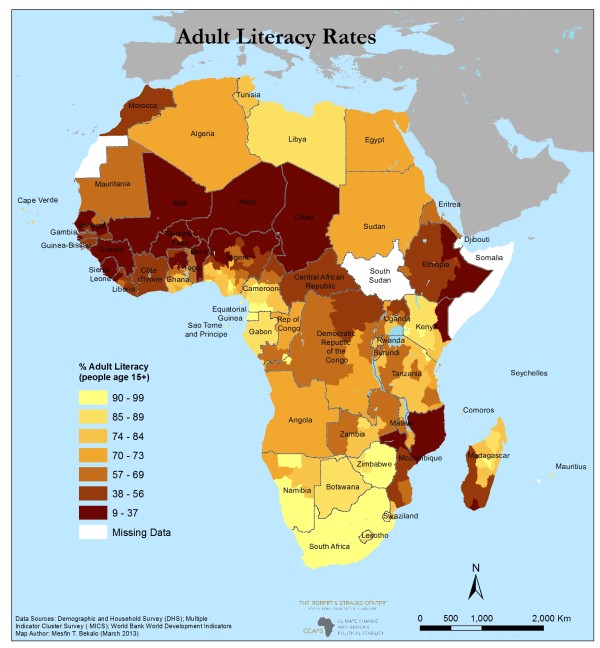
Todd Smith, Anustubh Agnihotri, and I have put together a new resource of subnational education and infrastructure access indicators for Africa, released as part of the Climate Change and Africa Political Stability (CCAPS) program at the University of Texas. This dataset provides data on literacy rates, primary and secondary school attendance rates, access to improved water and sanitation, household access to electricity, and household ownership of radio and television. The new CCAPS dataset includes data for 38 countries, covering 471 of Africa’s 699 first-level administrative districts. ...
A common complaint among international-relations scholars is that our journals don't sufficiently engage with big, new, and pressing issues of world politics. Those that do, on the other hand, often get criticized for a lack of rigor. I've made this complaint before, in the context of the financial crisis, and Kate Weaver offered some thoughts about "what's wrong" with IPE. But the problem extends far beyond the financial crisis and IPE. Standard explanations for this state of affairs include: the length of the publication cycle: it can take years to get from paper, to submission, to making...
Just a handful of things today.... Michael Krepon: "inferred vs. demonstrable deterrence." Election fraud, the 1862 election, and the outcome of the Civil War. Matt Fay likes the new Lieber and Press article on nuclear terrorism. "Prisoner's Dilemma" is a metaphor, but I suppose it was only a matter of time before someone tried it on actual prisoners. Via lots of academics. Robin Hanson riffs on metrics for scholars.... and elaborates a notion of "impressive power." And also: I used to drive the spouse to work via Logan Circle, back when it was largely known to outsiders as a hangout for...
Editor’s Note: This is a guest post by Kavita Khory, Professor of Political Science at Mount Holyoke College. Last spring the Combined Jewish Philanthropies (CJP) of Boston invited me to participate in a weeklong study tour to Israel. Designed for scholars of international relations, political science, and public policy, the purpose of the educational tour was to provide an “in-depth firsthand exposure” to Israel and promote a “deeper understanding” of its politics and society. The faculty study tour, now in its fourth or fifth iteration, is billed as the cornerstone of the organization’s...
Amazon created a platform called Mechanical Turk that allows Requesters to create small tasks (Human Intelligence Tasks or HITs) that Workers can perform for an extremely modest fee such as 25 or 50 cents per task.* Because the site can be used to collect survey data, it has become a boon for social scientists interested in an experimental design to test causal mechanisms of interest (see Adam Berinsky's short description here). The advantage of Mechanical Turk is the cost. For a fraction of the expense it costs to field a survey with Knowledge Networks/GfK, Qualtrics, or other survey...