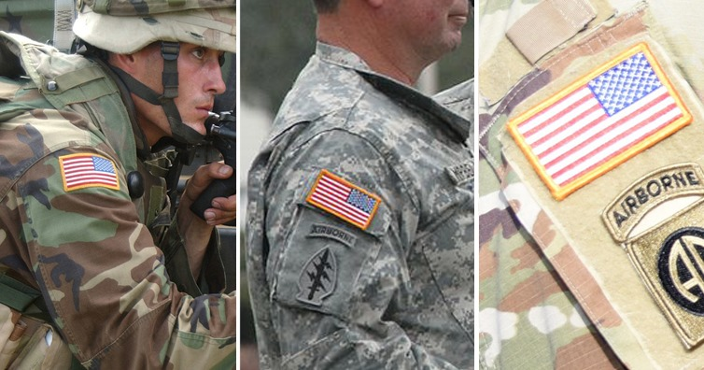
There is more continuity in the history of U.S. military basing policy than is typically assumed.
Gentle reader*, People that have an itch at scribbling generally entertain their visitors with their happy projects, high flights, and wonderful publications, therefore 'tis to be supposed...
As someone who works on religion and politics, I encounter the term "soft power" a lot. Most of the time it's in a good way; soft power is a means to advocate for policies that draw on our values...
US President Donald Trump gestures as he arrives to a "Make America Great Again" campaign rally in Cincinnati, Ohio, on August 1, 2019. (Photo by SAUL LOEB / AFP) (Photo credit should read SAUL...
pic.twitter.com/hOgO7uOmk2 — Robinson Meyer (@yayitsrob) November 30, 2016 I'm not going to assume that all of our readers are non-Trump fans, but let's be honest, Trump support in the social science academy is probably slim. And, if you are like me, you are dismayed by what transpired with the election and continue to try to figure it out, both personally as a human being and as a citizen of whatever country you are from. At moments, you think, maybe it won't be so bad, but then he tweets or says something and you fear it will be worse. I think Americans are often preternaturally disposed...
This post is a co-authored piece: Heather M. Roff, Jamie Winterton and Nadya Bliss of Arizona State's Global Security Initiative We’ve recently been informed that the Clinton campaign relied heavily on an automated decision aid to inform senior campaign leaders about likely scenarios in the election. This algorithm—known as “Ada”—was a key component, if not “the” component in how senior staffers formulated campaigning strategy. Unfortunately, we know little about the algorithm itself. We do not know all of the data that was used in the various simulations that it ran, or what its...
After Donald Trump won the elections in the US, Twitter was abuzz with the picture of potential UN Security Council country leaders that included Theresa May, Donald Trump, Vladimir Putin, Xi Jinping and Marine Le Pen. So now all eyes are on France and its upcoming presidential elections. The possibility of ‘Frexit’ in case of Le Pen’s win is alarming enough, but Russia is also on the agenda. Russian-French relations have been strained since the beginning of the Ukraine crisis, but have got even worse after President Hollande accused Russia of war crimes in Syria that purportedly prompted...
This World Politics in a Time of Populist Nationalism (WPTPN) guest post is written by Phil Arena, a Lecturer at the University of Essex. He has previously held positions at the University of Rochester and the University at Buffalo. His primary interests are interstate conflict and the links between domestic and international politics. His research has appeared in International Studies Quarterly, Journal of Conflict Resolution, Political Science Research and Methods, International Theory, Journal of Theoretical Politics, and elsewhere. He used to maintain a blog at fparena.blogspot.com,...
‘I want to ride around Moscow with an American flag in my car. If I find one. Join me! They have earned it'. If you were wondering who else was celebrating Trump’s win, it was the Editor-in-Chief of Russia Today Margarita Simonyan. Overnight, a deep-seated Russian Anti-Americanism and disbelief in American democracy was turned into almost unending love, although Russian Prime-Minister Medvedev still finds the name ‘Americano’ too unpatriotic for coffee and proposed to rename it into ‘Rusiano’. The US election results came as a big surprise in Russia as well. According to many sources, most...
Trump’s election may amount to an inflection point in the institutional fabric of our political system. I do not simply mean our domestic republican institutions. I also mean the broadly liberal-republican international order constructed after World War II. Indeed, these two sets of institutions are profoundly bootstrapped to one another. This dual threat amounts to the greatest challenge to the American experiment since the early years of the Cold War.
This is a guest post by Eric Grynaviski, an Associate Professor of Political Science at International Affairs at George Washington University. He is the author of Constructive Illusions (Cornell, 2014) .He studies sociological approaches to cooperation and conflict, and international ethics. Over the last few days, protestors have taken to the streets to combat what they believe is an evil power that will soon occupy the White House. The problem of evil has featured in rhetoric about this election, in fact, for months, as featured in the Washington Post commentary on the election. The tropes...
Well, that was unexpected. But it’s happened. The question now is, how will the election of Donald Trump change international relations? That question itself is overwhelming on multiple levels. There are Trump’s personal international business ties, unparalleled in modern American political history. There’s his wariness of multilateralism and diplomacy. There’s his stated intention to go after China. There’s Trump’s lack of experience in international relations, which suggests that his advisers are likely to be even more important (and the names of people being bandied about for top...