Academics depend on slow processes subject to unfortunate slowdowns. And, unfortunately, academic timelines can make or break careers.
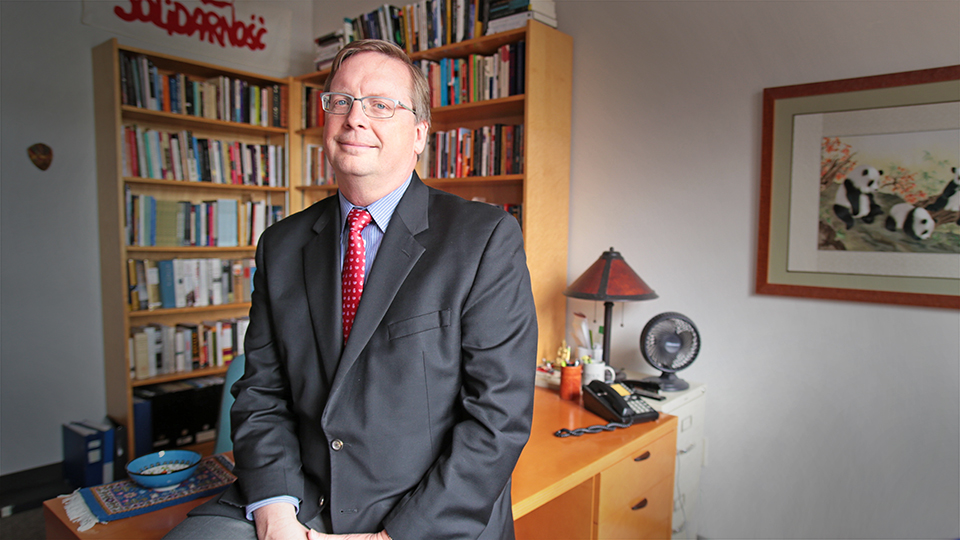
This is a guest post from Sean Kay, Robson Professor of Politics and Government, and Director of International Studies, at Ohio Wesleyan University. The interview quotes appear in his new...
While the Russia probe is expanding to include naïve 36-year old Harvard graduates, pundits all over the world have been worried about elections in other countries. The massive WikiLeaks dump (pun...
In the aftermath of Trump's visit to Brussels one dynamic has been overlooked. It starts with a basic reality of NATO: when there is a mission, countries are not obligated to hand over military...
G. John Ikenberry has a post up at TPMCafe on what he terms the "security trap". The piece argues that a number of major changes (American Unipolarity, a 'revolution' in the concept of state sovereignty, lack of common threat as in the Cold War, and the rise of a more democratic international...
The BBC (via FP Passport, my new favorite 'msm' blog) is reporting that Iran and Russia may have yet again reached a deal to shift the enrichment of Iranian uranium to Russia.Iran's ambassador to the International Atomic Energy Agency (IAEA), Ali Asghar Soltanieh, told Iranian radio he had struck...
Yesterday, Kevin Drum had an interesting piece on the failure of the Bush administration to take Iran up on an offer to talk about its weapons program and support for anti-Israeli terrorists shortly after the President declared the end of 'major hostilities' in Iraq. The story goes that Tehran...
After having previously vowed to speak candidly with Chinese President Hu Jintao about affording more political and social freedom to Chinese citizens, President Bush managed to miss a golden opportunity and let diplomatic nicety get in the way.Most should by now be aware of the vocal protester...
Chinese President Hu Jintao is in town to meet with our own commander-in-chief and while I am sure most people are focusing on the more visible issues of trade, currency valuation, and nuclear proliferation I like to look at the apparently insignificant, yet likely-to-cause-diplomatic-hay types of...
The Atlantic Monthly recently asked a group of foreign policy "insiders" a number of questions about US foreign policy. The poll results were in the April 2006 issue, which is hidden behind a subscriber wall. The magazine greatly limited the possible poll answers. For example, the insiders were...
Thanks to Dan, I read the interesting AU piece about Patrick. This is what caught my eye:“We wouldn’t have a car culture if it weren’t for superhighways,” he says. “The whole idea of being able to drive a car depends on the existence of a certain set of infrastructures. Material infrastructures,...
Back in 1976, the eminent political scientist Robert Dahl pointed out a common error in the analysis of power among social theorists: the tendency to assume that power was a unit-level attribute, something that a unit or actor possessed in isolation. This was hardly a new observation, but Dahl did...
Check it out as American University promotes our very own Patrick Jackson. For example:It was Jackson’s dedication toward students that brought him to AU. Attracted by the school’s emphasis on instruction and the opportunity to teach a course on his beloved science fiction (as it relates to world...
The Chronicle reports on a rather old problem in the electronic peer-review process: editors, authors, and reviewers forwarding Word documents without scrubbing the properties, tracked changes, and other sources of embedded data likely to reveal a writer's or reviewer's identity. Henry Farrell...
During the late 1980s and the 1990s academic international relations was dominated by the so-called "paradigm wars." Scholars argued over -- and oriented their writings towards -- the major three "isms": realism, liberalism, and constructivism.[1]The degree to which arguments about the "isms"...
The role of insults -- and the corrolary role of honor -- in world politics represents an odd topic in international-relations scholarship. Everyone knows insults and honor matter a great deal. Some scholars write about them -- or, at least, related topics like "prestige" -- but no one seems to be...