The New York Times recalls her as a post-9/11 public intellectual who served as an "intellectual beacon" and "guiding light for policymakers" during a tumultous political era. The Atlantic describes her as a uniquely non-secularist scholar, whose "greatest legacy" was her "serious intellectual commitment to including God in discussions of politics." At Crooked Timber, Corey Robin counters the notion that she was a "realist" and criticizes her...
Displaying Results for ""
Academic Conferences: From “Networking” to Forming and Nurturing Social Ties
I don't care much for APSA. Indeed, this year I am continuing my recent tradition of skipping it entirely. But it always occasions discussion in the political-science blogsphere. This year the focus of that discussion, at least as it pertains to conferencing as an activity, appears to be on "networking." Steve recently echoed the substantive part of Brian's post in recommending a focus on meeting younger scholars rather than pursuing brief...
The Other Dimensions of Inclusion (and Exclusion) in Political Science
Dan's post on his self-experiment in raising citations to female scholars has drawn a critical comment from someone who wonders about whether similar patterns exist with reference to minority scholars and scholars from outside North America. The issues of gender, race, and national (regional) origin are distinct, but if we're going to have a wide-ranging discussion about inclusion and exclusion in the field then we ought to address these issues...
The Citation Gap: Results of a Self-Experiment
Both because of the unexpected direction yesterday took, and because I haven't worked through my thoughts about any number of pressing current events, I thought I'd write about an experiment that I've been engaging in with my recent academic papers. You might recall the Maliniak, Powers, and Walter paper (soon to be out with International Organization) on citations and the gender gap. As Walter reported at Political Violence @ a Glance:...
Recent Reading List
I have been thinking of listing a bunch of my favorite 2000s+ Political Science books, and a variety of circumstances has inspired me to finally write the list . These books make my list because they made me see the world differently. Most persuaded me of their core arguments, but all made me think and even ask questions I had never asked before. My reading is fairly random as my interests are fairly wide (I read and research in IR and...
Why I Pulled the Post
Some of you have asked why I pulled the post, “Intellectual Jailbait: Networking at APSA,” which I put up last night. First, a lot of people were obviously hurt by the post. Those of us who blog of course want to be read, and I try to use humor to get my points across. I think that most humor, or at least mine, tries to go up to the edge of inappropriateness without crossing it. You don’t know until you cross it until you do, however. I would...
Networking is Hard-Working
The question of networking tends to arise as conferences approach. With APSA less than two weeks away (which means discussants are going to be getting papers any day now--ok, in about a week if they are lucky), I thought I would post some thoughts about networking. There was a post earlier today that did address such stuff, but, well, stuff happened. A key point was lost in the course of events--that networking sideways and down is far...
More Papers, Please: Video Games and International Studies
In our conclusion to Kiersey and Neumann's Battlestar Galatica and International Relations, Peter Henne and I lament the relative lack of interest among cultural-turn international-relations scholars in video games. Our case rests on a comparison of the number of people who have played franchises such as Halo and Mass Effect to those who have watched the re-imagined BSG. But the downside to neglect isn't simply about the size of audience and...

Thursday Morning Linkage
Sad turn of events in Egypt, a situation in which the U.S. is inextricably implicated. Not sure if there was a policy course we should have followed that would have been different. I understand the defenders of the democratic process who would have wanted Morsi to leave via the ballot box. I also am sympathetic to the claims that the Muslim Brotherhood was running the country in to a ditch. Unfortunately, the military response seems to have...
Sexual Harassment in Political Science and International Studies
The last two years saw some major stories in my corner of the blogsphere concerning sexual harassment. Colin McGinn's resignation from the University of Miami saw widespread discussion across the academic interwebs, even if we didn't say much about it. McGinn's case seems not terribly unique in philosophy, as the What's it Like to be a Woman in Philosophy blog has been chronicling for years. Sexual harassment at science-fiction conventions is...
Where Are All the Republican Realists?
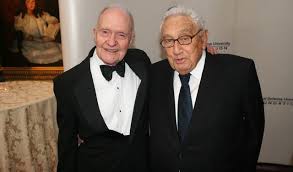
In light of the brouhaha between Chris Christie and Rand Paul over foreign policy, conservative columnist Ross Douthat opined in The New York Times that the Republican Party seems to be missing the sort of realist pragmatists of old that might have mediated between these views. He attributes the realist decline to them being out of step on domestic politics and just not really liked by different factions on foreign policy. He writes: However,...
The (American) Job Market and Interpretive Methods in Political Science
M. David Forrest, a soon-to-be-assistant-professor of American politics, forwarded the following letter to the "interpretation and methods" listserv. He agreed to let me post it at the Duck. Given the methodological heterogeneity of our readership, I thought it would be of interest. It reads: [I am an American Politics scholar who primarily uses interpretive methods and methodologies (IMM) and recently came off the Assistant Professor job...