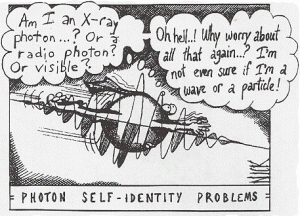
A state of mind is a contagious thingSpread it around you never know what the future brings…Marillion, “State of Mind” n his later writings, Ludwig Wittgenstein spends quite a bit of time thinking about the problem of exactly what we are...

Tough as it is to follow Charli’s excellent post on terrorism, somebody has to do it and so I might as well. If this past ISA is any indication, quantum is a big deal. The panel on Alex Wendt’s new...
The idea of prediction in the study of international relations has been a persistent thought in my head for some time. Ostensibly, in our (mostly) non-experimental discipline, prediction represents...
I woke up this morning to read (a few hours behind most of you...one of the few downsides to living in the Pacific Northwest is living behind the news cycle!) about the finalizing of a nuclear deal...
Editor's Note: This is a guest post by Chris Brown. It is the seventh installment in our "End of IR Theory" companion symposium for the special issue of the European Journal of International Relations. SAGE has temporarily ungated all of the articles in that issue. This post refers to Brown's article (PDF). A response, authored by David Edelstein, will appear at 10am Eastern. Other entries in the symposium--when available--may be reached via the "EJIR Special Issue Symposium" tag. In their invitation to contribute to the Special Issue, the EJIR editors appeared to approach contemporary IR...
The European Journal of International Relations-Duck of Minerva symposium on "The End of International Relations Theory?" has concluded. This is an informational post that will remain at the top of the page for the duration of the event. The symposium runs 7 September-18 September. It features twenty-five planned posts consisting mostly of teasers of articles in the special issues and responses to those articles. Each teaser appears at 9.15am Eastern. The response to the article at 10.00am Eastern. You can view all of the available entries in the symposium — in reverse chronological order —...
Editor's Note: This is a guest post by Stacie E. Goddard. It is the sixth installment in our "End of IR Theory" companion symposium for the special issue of the European Journal of International Relations. SAGE has temporarily ungated all of the articles in that issue. This post responds to Andrew Bennett's article (PDF). His post appeared earlier today. Other entries in the symposium--when available--may be reached via the "EJIR Special Issue Symposium" tag. I am excited to blog about this EJIR special issue on theory and international relations, and am particularly pleased that I’ve...
Editor's Note: This is a guest post by Andrew Bennett. It is the fifth installment in our "End of IR Theory" companion symposium for the special issue of the European Journal of International Relations. SAGE has temporarily ungated all of the articles in that issue. This post refers to Bennett's article (PDF). A response, authored by Stacie E. Goddard, will appear at 10am Eastern. Other entries in the symposium--when available--may be reached via the "EJIR Special Issue Symposium" tag. As the internet lends itself to a rather different tone from that of referred journals, I adopt the pose of...
Editor's Note: This is a guest post by Dan Reiter. It is the fourth installment in our "End of IR Theory" companion symposium for the special issue of the European Journal of International Relations. SAGE has temporarily ungated all of the articles in that issue. This post responds to John J. Mearsheimer's and Stephen M. Walt's article (PDF). Their post appeared earlier today. Other entries in the symposium--when available--may be reached via the "EJIR Special Issue Symposium" tag. Thanks to John Mearsheimer and Stephen Walt for writing such an important and provocative article. I agree...
Editor's Note: This is a guest post by John J. Mearsheimer and Stephen M. Walt. It is the third installment in our "End of IR Theory" companion symposium for the special issue of the European Journal of International Relations. SAGE has temporarily ungated all of the articles in that issue. This post refers to the article of the same name (PDF). A response, authored by Dan Reiter, will appear at 10am Eastern. Other entries in the symposium--when available--may be reached via the "EJIR Special Issue Symposium" tag. Theory is the lodestone in the field of International Relations (IR). Its...
Editor's Note: This is a guest post by Inanna Hamati-Ataya. It is the second installment in our "End of IR Theory" companion symposium for the special issue of the European Journal of International Relations. SAGE has temporarily ungated all of the articles in that issue. This post responds to the introduction (PDF), written by Tim Dunne, Lene Hansen and Colin Wight. Their own post is available here. Other entries in the symposium--when available--may be reached via the "EJIR Special Issue Symposium" tag. The EJIR Special Issue is not only a new opportunity to collectively reflect on the...
Editor's Note: This is a guest post by Tim Dunne, Lene Hansen and Colin Wight. It is the first installment in our "End of IR Theory" companion symposium for the special issue of the European Journal of International Relations. SAGE has temporarily ungated all of the articles in that issue. This post refers to the issue's introduction of the same name (PDF). A response, authored by Inanna Hamati-Ataya, will appear at 10am Eastern. Other entries in the symposium--when available--may be reached via the "EJIR Special Issue Symposium" tag. In an academic discipline as wide-ranging as...