Intra-elite, state-centric society is a strategic front, and ought to be defended and put to use in the continued development of a global and decolonial turn in IR.
It turns out that it’s hard to write a roundup of happenings at the Duck of Minerva when there aren’t many to speak of. Much of that’s on me. What’s my excuse? Well, the kid finally contracted...
Our next Bridging the Gap Book Nook features Emmanuel Balogun, an assistant professor of political science at Skidmore College and Bridging the Gap's inaugural Diversity, Equity, and Inclusion...
I wrapped the 2022 edition of my undergraduate “Grand Strategy” seminar this past Tuesday. This must have the eight or ninth iteration of the class. I like teaching it. I really do. But I have...
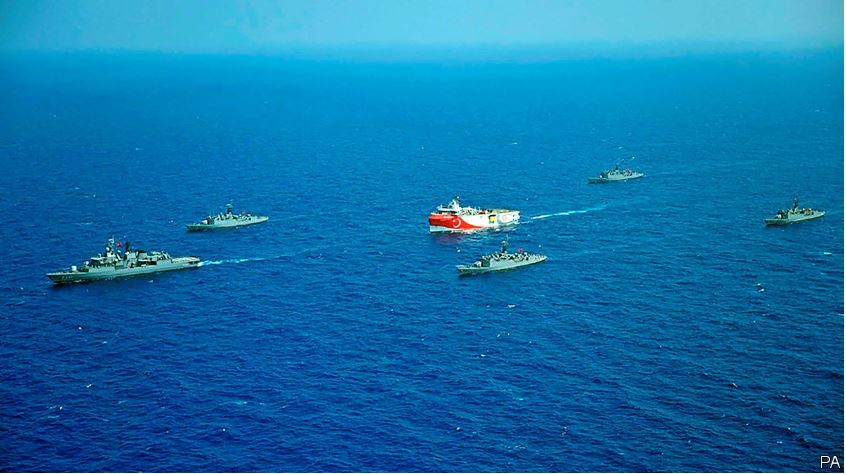
We open each of my undergrad classes with a discussion of current events. In the past four years, there have been several times that students have wondered whether a war may be about to break out: between America and North Korea, America and Venezuela, India and China, Qatar and Saudi Arabia...America and Iran. We spend a lot of time talking about the issues, the motivations for each state's behavior. And when "nothing" happens, I always wonder whether all the time we spent was worth it. I'm wondering the same thing about tensions in the Eastern Mediterranean. If the situation defuses...
With the coronavirus, it has been hard for many of us to just keep going, let alone set aside time to blog (certainly not as much as we otherwise might!). So, we wanted to acknowledge that by giving our guest Ducks from last year an additional semester (at least!) to have this platform for talking about substantive issues in international relations and the academy. We are thrilled that folks have stayed on. Please read their work to date and be on the lookout for new posts. There are some really good ones on a range of topics. If you have an interest in becoming a guest contributor come...
This is the fifth post in the our series Race&IR. Black Lives Matter has spearheaded a massive reckoning of race relations in the US and around the world, but not so much in Russia. The discipline of IR may have started a bit earlier than this year’s protests: there have been a number of interventions that have brought the issue of race to the forefront of teaching and research – even though it should have always been there at least since DuBois. Not everyone is happy though: right-wing media cry “cancel culture” and debates on the merits of critical approaches somehow...
I'm working on a new project about the use of religion in power politics (part of which I'll be presenting "at" APSA this week). I'm finding good evidence, but the framing is tricky. Religion as a power political tool happens, and matters, but it rarely works out the way the wielders intended. Is this an example of ideas mattering in international relations, or an example of their limits? The fact that I feel forced into such a binary reflects a broader issue in the sub-field. As we all learn in Intro to IR, the study of ideas revolves around constructivism. With the emergence of neorealism...
Eric Van Rythoven (PhD) is an Instructor in the Department of Political Science at Carleton University in Ottawa, Canada. His research focuses on the intersection between the politics of emotion, International Relations, and security. His articles have been published in the Journal of Global Security Studies, the European Journal of International Relations, Security Dialogue, among others and he is the co-editor (with Mira Sucharov) of Methodology and Emotion in International Relations (Routledge, 2019). You can learn more about his research and writing at his website. This...
David C. Kang is Maria Crutcher Professor of International Relations at the University of Southern California, where he also directs the Korean Studies Institute. His latest book, coedited with Stephan Haggard, East Asia in the World: Twelve Events that Shaped the Modern International Order, will be published Cambridge University Press next month. This summer, the graduate students in our Ph.D. program here at USC, and the undergraduates as well, called for an end to the Eurocentric curriculum in our department. They noted that there are twice as many classes devoted to Europe as there are...
Photo courtesy of the European Union. Used under Creative Commons License. This is a guest post by William Akoto, a postdoctoral researcher jointly appointed at the Sié Chéou-Kang Center for International Security & Diplomacy at the Korbel School of International Studies, University of Denver, and the One Earth Future Foundation. In the fall, he will begin a tenure-track appointment at Fordham University. Universities are under increasing pressure from politicians, funders and the public to demonstrate the broader social value of their work. In response,...
This is a guest post by Jeffrey C. Isaac, James H. Rudy Professor of Political Science at Indiana University, Bloomington. You can follow him at his blog at Democracy in Dark Times. Democracy is a central and arguably the central theme of contemporary American political science research and teaching. This is certainly true in the “subfields” conventionally designated as “Comparative Politics,” “American Politics,” and “Political Theory.” And even where it is not the central theme, as in most “International Relations” inquiry, it is an important theme. By far the most broadly influential...