Robert Cox’s landmark article, “Social Forces, States and World Orders: Beyond International Rela…
Articles by authors with foreign-sounding names are cited far less than those written by people with “typically-American” names.
In 2014, John Mearsheimer authored a Foreign Affairs article in which he blamed that year’s Ukrai…
Back in the Duck of Minerva's heyday, Jon Western was one of its anchors. Indeed, it wasn't that long ago that we were talking about his returning. Jon said that he'd gained important perspective on...
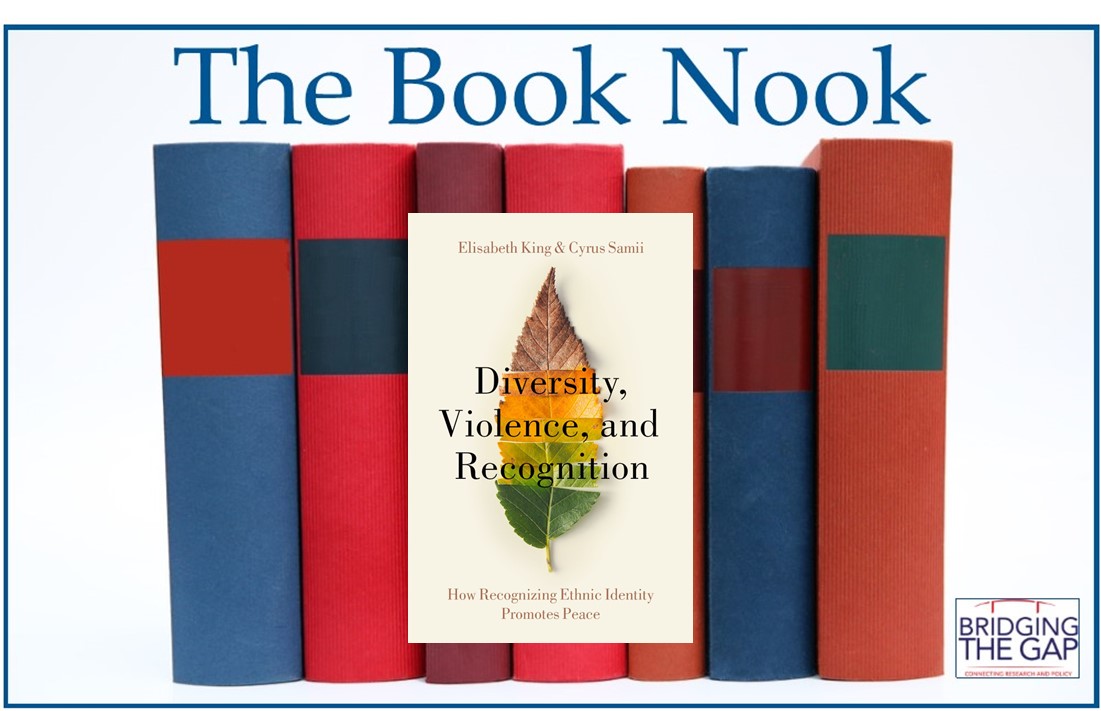
https://www.youtube.com/watch?v=Dz4nVxxllTo This entry in the Bridging the Gap Book Nook series comes from Elisabeth King and Cyrus Samii of New York University. In their new book, Diversity, Violence, and Recognition (Oxford, 2020), they address key questions for peace-building in multi-ethnic societies: Under what conditions do governments manage internal violent conflicts by formally recognizing different ethnic identities? And what are the implications for peace?
Guest post by Sandor Fabian is a PhD candidate at the University of Central Florida and instructor of record at the NATO Special Operations School. His research is in security studies with a focus on new concepts of conflict, U.S. foreign military aid, and counter hybrid warfare. Follow him at @SandorFabian2 and Doreen Horschig is a PhD candidate and teaching associate at the University of Central Florida. Her research is in nuclear security with a focus on public and elite opinion on nuclear weapons and norms of weapons of mass destruction. Follow her at @doreen__h By now the world has...
The following is a post by ISA journal editors Krista Wiegand (International Studies Quarterly), Debbie Lisle (International Political Sociology), Amanda Murdie (International Studies Review), and James Scott (International Studies Perspectives). There has been a lot of talk in academia about the many negative consequences the COVID-19 pandemic has generated, ranging from declining enrollments, inability to travel for field research or conferences, and research productivity working from home. As editors of the International Studies Association (ISA) journals, we started noticing some new...
Like so much else in international relations, the answer to this question seems "obvious." But, like so much else, it gets trickier when we really investigate the situation, and it reveals nuances to international relations that many scholars and policy analysts overlook. About a week ago, Egypt sent medical equipment to the United States to help in the fight against Covid-19. The packages were printed with "From the Egyptian People to the American People." This prompted many dark jokes, as Egypt is currently suffering a major Covid-19 outbreak it is struggling to contain. Then Turkey...
This is a guest post by Philipp Schulz, who is a Post-Doctoral Researcher at the Institute for Intercultural and International Studies (InIIS) at the University of Bremen. Philipp’s research focuses on the gender dynamics of armed conflicts, with a particular focus on masculinities and wartime sexual violence. His book ‘Male Survivors of Wartime Sexual Violence – Perspectives from northern Uganda’ is forthcoming with University of California Press. Academic competitiveness and pettiness is alive and real. From expediting demands of the competitive academic job...
When I was a grad student, I had the privilege of student teaching with political theorist Eric MacGilvray. Eric was—and I’m sure still is—a brilliant teacher. He was always in motion, but in a way that felt deliberate. He often perched on an elevated windowsill while listening to students debate amongst themselves. He made even the most archaic and dense texts accessible. (The class was Classics of Social and Political Thought.) He also had a unique approach to grading. Rather than marking on a scale of 100, where 94 is an A, he introduced a seven-point scale. Actually, it was a ten-point...
Restraint in US foreign policy is having a moment. That's a good thing. But I worry it's unclear whether restraint is a means or an end, and what that end would be. Without resolving this--preferably in favor of re-imagining a continued US leadership role in the world--current calls for restraint may do more harm than good. The popularity of restraint in US foreign policy should be making me happy. I went to college in the Bush years, and marched against the Iraq war. After graduating, I joined a group in DC trying to formulate a smart, progressive foreign policy vision. A few years later I...