Academics depend on slow processes subject to unfortunate slowdowns. And, unfortunately, academic timelines can make or break careers.
Each Spring, Bridging the Gap (BTG) announces the recipients of our annual Policy Engagement Fellowships (PEF), the purpose of which is to support efforts by scholars to connect their research on...
Guest post by Tiffany S. Chu, Alex Braithwaite, Faten Ghosn, and Justin Curtis Plans to fund a border wall at the U.S.-Mexico border are troubling D.C. politics. During his campaign for the...
This is a guest post by Betcy Jose and Alessa Sänger. Jose is currently a Fellow in the Cluster of Excellence: Formation of Normative Orders at Goethe University. Sänger is pursuing a Master Degree...
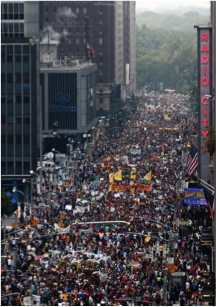
This is a guest post from Jennifer Hadden, who is an assistant professor at the University of Maryland. She guest blogged on the Duck before on global climate negotiations. She also has a forthcoming book from Cambridge on climate advocacy called Networks in Contention: The Divisive Politics of Climate Change. The largest climate change demonstration in history took place on Sunday. According to organizers of the People’s Climate March, an estimated 400,000 people participated in the protest in New York. For comparison, the size of the march was comparable to the scale of the February 15...
It is no secret in the academic IR community that securitization theory, an approach developed in Europe as part of the Copenhagen School of security studies, has struggled to get traction here in the United States. While the approach is widely used elsewhere in the world, from Europe to Asia, American IR scholars have been very reticent reluctant to accept the merits of the approach. Which is a shame because the approach has the potential to offer significant insights. One possible objection to securitization theory might be that, since it argues threats are political and intersubjective...
Welcome to the second edition of "Tweets of the Week." It was a busy seven days for news and my twitter feed provided much useful information -- in micro-form. The Scottish independence referendum featured especially prominently in my feed. This was perhaps my favorite tweet about the final result: Prior to the vote, my feed was filled with some great tweets about the #indyref. Here are a few of the shorter ones that I found especially helpful: https://twitter.com/johnpmcdermott/status/512346430908805120 https://twitter.com/ZiggyRoswell/status/510153980144787457 The Scottish referendum, of...
Russia may have agreed to a ceasefire with Ukraine the week before last, but in addition to regular violations of it by both Russian forces and pro-Russian rebels, it is important to understand that what not long ago was considered an irregular conflict has transitioned into open warfare between Russia and Ukraine. Most of the fighting ended in a ceasefire when President Poroshenko -- weakened by the West's refusal to provide lethal equipment and the failure of the NATO summit to address the Kremlin threat in a fully comprehensive fashion -- accepted Putin's terms. This ceasefire is...
On Tuesday September 23, the United Nations Secretary General Ban Ki Moon is hosting a meeting of world leaders to discuss the issue of climate change. The aim is to build pressure and support for action in advance of the climate negotiations to be held in Paris in late 2015. In advance of Tuesday's climate meeting, activists are holding on Sunday, September 21st the People's Climate March, what aims to be the largest march of its kind with a core march in New York and satellite marches in major cities around the world. The hashtag #Climate2014 is capturing much of the news about the...
[Note: This is a guest post by David M. McCourt, an assistant professor in the Department of Sociology at the University of California-Davis. His book, Britain and World Power Since 1945: Constructing a Nation’s Role in International Politics, has just been published by University of Michigan Press.] On Thursday the Scottish people will go to the polls to vote on independence from the United Kingdom, with the prospect of a “yes” vote more realistic than many believed only a few weeks ago. This raises important questions for Britain’s role in the world, and by extension for the future of...
Today, the Chicago Council on Global Affairs (CCGA) released their biennial report of U.S. public attitudes on foreign policy, drawn from a large national sample carried out in May of this year. This year, my co-author Jon Monten and I participated in the team that designed the survey and analyzed the findings. [As an aside, we also have been working with CCGA to revive the leader surveys that CCGA administered for many years. Jordan Tama, Craig Kafura, Jon and I presented our first set of findings from the leader surveys at #APSAOnFire. We hope to release a report this fall with the data to...
What I remember most about my post-grad Gender and Politics seminar were the extensive discussions we had about having babies. It was 2004, and debates about babies vs careers, and whether women should 'opt out' to raise families, were heated and divisive. Women were told in the 1980s and 1990s that the highest feminist aspiration was to wear oversize, terrible suits and work alongside men- as equals (or at least work alongside men, while accepting less pay and dealing with harassment). This was followed by the movement to denounce the double-day; the New York Times and Time Magazine led the...