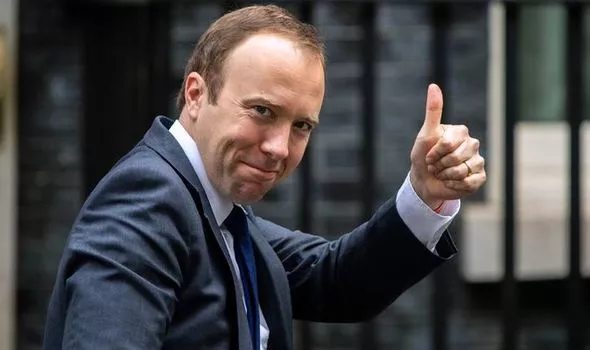
Matt Hancock, a Conservative MP and the UK’s Health Secretary during most of the Covid lockdowns, has failed upwards.
Failing Upwards and Global Elitism
read more
Matt Hancock, a Conservative MP and the UK’s Health Secretary during most of the Covid lockdowns, has failed upwards.

Readers of the Duck will be very familiar with Duck editor Josh Busby's commentary on climate change and security, U.S. foreign policy, and a host of other topics. Earlier this year, Bridging the...
The following is a guest post by Mason Richey, an associate professor of international studies at Hankuk University of Foreign Studies. I am Trump; I am Trump. Trump I am. That...
This post in the Bridging the Gap series comes from Peter Henne, Assistant Professor at the University of Vermont and a 2017 participant in BTG's International Policy Summer Institute. Earlier this...
This is a guest post by Ari Kohen, Associate Professor of Political Science at University of Nebraska-Lincoln. He blogs at Running Chicken and tweets @kohenari. As I write this, Twitter and Facebook inform me that air raid sirens are going off in Jerusalem and Tel Aviv, as well as several cities and towns closer to the Gaza Strip, while Israeli forces have launched air strikes against Gaza and are considering the mobilization of as many as 40,000 reservists for a possible ground incursion. The numbers of dead, wounded, and terrorized are mounting. This most recent escalation comes on the...
As I wrote a few days ago, a new pattern of warfare is emerging in the Middle East and Africa. This “new blitzkrieg” isn’t really new, but it is asymmetric warfare at its best, pitting swarms of fast-moving, lightly armed fighters operating as a network against hidebound hierarchies of Western-trained and equipped “professional soldiers”. These state forces have a bad track record of crumbling under the tempo of swarming, networked attackers; and the only thing that has proven capable of stemming the tide is early airstrikes followed with a robust military “prop-up and mop-up” campaign, as...

This might be might last football related post, what with the World Cup coming to a close and host country Brazil departing ignominiously from the competition by a margin of 7 to 1 in the semifinal against Germany. I've got a few football/Brazil related links for this week. I'm sitting on a goodly number of climate change and conservation related themes that I'll come back to in coming weeks. I'm also aiming to write about restive criticism of President Obama's foreign policy, both by the usual suspects as well as some more unlikely folks like Peter Beinart. I'll leave that to a later post....
This is a guest post by Matthew Bolton, Assistant professor of political science at Pace University and author of Foreign Aid and Landmine Clearance. He blogs at Political Minefields. Imagine never knowing whether your next step will be your last, whether your children are safe in the fields around your house, whether objects they find in the street are toys or deadly explosives. For people living where landmines lie in wait long after wars end, such frightening thoughts are daily realities. “The humanitarian impact is heartbreaking,” said Kiman Lucas of Clear Path International, which...
Just over a week ago – two days before the discovery of the bodies of the three abducted Israeli teenagers and four days before the abduction and revenge killing of Muhammed Abu Khdeir -- I sat in the family quarters of a young Palestinian shop owner in Jersusalem’s Old City sipping mint tea with two colleagues. We met the young shop owner and his two cousins while bargaining over some textiles in the Muslim quarter of the Old City. At the conclusion of the sale, they thanked us for a rigorous negotiation and invited us to their family quarters where they had a museum style display of...

Over the July 4th weekend, UT System Chancellor Cigarroa demanded that UT President Bill Powers resign or be fired by July 10th. Bill Powers refused but offered a timetable to step-down. Supporters of the embattled president have launched a petition drive that now has nearly 8500 signatures. At stake is the future of higher education in the state of Texas and whether or not Texas values tier 1 research institutions. There has been a long-running battle in the state of Texas over higher education, with Governor Rick Perry and a number of his allies on the Board of Regents attempting to...
Just in time for you to head to the beach with a copy, my new book is now available from Cornell University Press.* As many of you know, this is the culmination of a my 6-year NSF-funded research project on why some human security problems get on the global agenda and others don't. The answer in a nutshell: it's all about what's going on within the advocacy networks. A teaser of the first chapter is here. A nice write-up by the Chronicle of Higher Education is here. The book includes a longer version of the argument in this article, and three case studies on human security campaigns that...
Our periodic rotation of guest bloggers is underway. This season's newcomers: 1) Jarrod Hayes is Assistant Professor in the Sam Nunn School of International Affairs and is the author of Constructing National Security: US Relations With India and China. You may have seen his IO article on securitization, and his guest posts on nuclear policy, Crimea, the Arab Spring and other topics; and you probably know him as a long-time Duck reader and commenter as well. Jarrod is keen to blog on security, US / Asian foreign policy and climate change in between hiking, kayaking, and working on his house....