Exercising feminist curiosity: how Ukraine women are involved in the conflict and how Putin’s nationalist fever dream is a patriarchal one.

Sunflower seeds and Molotov cocktails
read more
Exercising feminist curiosity: how Ukraine women are involved in the conflict and how Putin’s nationalist fever dream is a patriarchal one.
This is a guest post by Philipp Schulz, who is a Post-Doctoral Researcher at the Institute for Intercultural and International Studies (InIIS) at the University of Bremen. Philipp’s research focuses...
Ah, the sweet time your baby becomes a toddler and maybe lets you sleep for more than 5 hours a night. Your teaching is sort of kind of on track, your scant article submissions get a steady number...
To illustrate this post, I would love to put that cute stock photo of a woman dressed in a taupe formal suit holding an adorable baby in a diaper, but it is just wildly unrealistic. For starters,...
It was with a distinct sinking feeling yesterday that I learnt that conference rooms for the EISA's upcoming 9th Pan-European Conference on International Relations have been renamed after eminent theorists of European origin and that there is not a single woman amongst those selected to be honored. A close reading of the conference program brought together the following list of names, which was posted on the Congrats, you have an all-male panel Tumblr: To add insult to injury, some conference rooms have retained their usual Italian names, so it's not even as though there wasn't space to...
It looks like the Obama administration has secured 42 votes for the Iran deal in the Senate, enough to filibuster even a vote, and despite today's machinations in the House, the Iran Deal will likely go through. Indeed, when Republicans agreed back in May to a review process that would require a super-majority in both chambers to overturn the deal, the die was already somewhat cast. Still, I'm thrilled that supporters have been able to hold the line in the face of a multi-million dollar campaign against the agreement. In the final days, we're seeing a surge in efforts to get views on the...
The following is a guest post by Jeff Colgan, Richard Holbrooke Assistant Professor at Brown University, and is @JeffDColgan on Twitter. It’s that time of year again, when professors are designing syllabi as fast as they can with deliberation and care. Recently I analyzed IR syllabi for PhD students. The data suggest a gender bias that instructors could easily correct. The case that gender diversity is good for IR and political science has been made elsewhere, repeatedly and persuasively. According to APSA, women are 42 percent of graduate students in political science (in the US), but only...
Yesterday’s post Confidence and Gender in International Relations got me thinking. The post draws on the excellent survey data from the Teaching, Research, and International Policy (TRIP) project at William and Mary’s Institute for the Theory & Practice of International Relations and notes that in the snap polls conducted by the project over the last year, women international relations scholars choose the response “I don’t know” more often than their male counterparts. They conclude that structural factors such as socialization might explain this “confidence gap” between female and male...
The following is a guest post by Rachel Merriman-Goldring, Susan Nelson, Hannah S. Petrie at William and Mary's Institute for the Theory & Practice of International Relations. For decades, survey research has suggested that women lack confidence in their answers, responding ‘don’t know’ or ‘maybe’ at significantly higher rates than their male counterparts. Initially, this trend on political surveys was attributed to topic-specific political knowledge gaps between men and women. However, recent research, including a study on the confidence gap between male and female economists,...
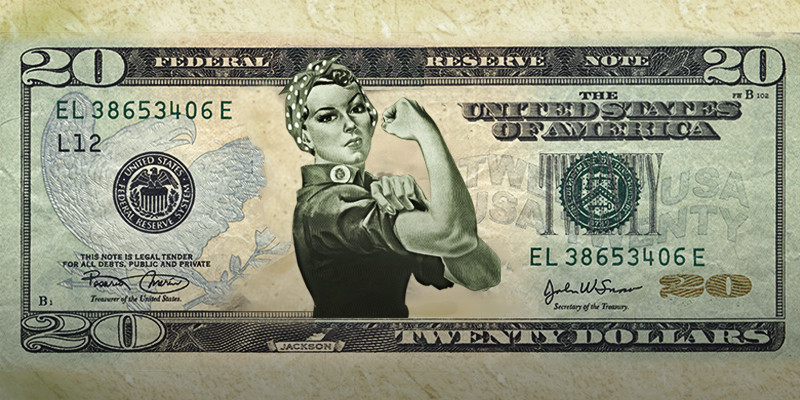
The grassroots advocacy campaign, Women on 20s, had a simple request: put a woman on the $20 bill by 2020 to commemorate the 100 year anniversary of the 19th amendment, which granted women the right to vote in the United States. Starting with a list of 15 women candidates, on-line voters cast an electronic ballot in the primary round and chose four finalists: Harriet Tubman, Eleanor Roosevelt, Rosa Parks and Wilma Mankiller. One month later, voters elected Harriet Tubman as their choice for the portrait on the twenty dollar bill. As the final votes were pouring in, Senator Jeanne Shaheen...
Last night, I posted this about sexism in political science. It has gotten a pretty strong response getting 10x as many hits (so far) as my usual post, lots of retweets by female political scientists, and some sharing on facebook. The sharing on facebook came with props as my female political science friends were happy to see a senior male political scientist talk bluntly about this. These props/kudos made me feel squishy because it is not that hard to blog and notice on occasion that there is sexism in the poli sci business (as it is everywhere as one FB friend noted). My female...
There is a discussion on PSR about sexism in political science, with most folks concurring that it is still an issue with some deniers pointing out that support groups for women are exclusive, too. Um, yeah. How to address such discussions? I go to my standard operating procedure: what have I seen over the years? The answer: a heap of sexism which has not gone away. First, there is the repeated myth that jobs are gamed for women and minorities, which explains why white men don't get jobs. Of course, this defines all women and minorities who do get jobs as less qualified. The problem...