Back in March, I wrote a post at Lawyers, Guns and Money called “Remember ‘Great Power Competition?’ Lol.” As the “Grand Strategy” of Trump 2.0 comes into focus, I thought it would be a good idea to revisit and update it. In brief, the normie...
The buzzword of the first Trump administration was “Great Power Competition.” That was also a lie.
Labour MP David Lammy has a new piece in Foreign Affairs called, “The Case for Progressive Realism.” Where his manifesto is punchiest is in its unsparing critiques of British foreign policy: the...
If international relations as a field is to have a just purpose—not just justifying the power-hoarding and power-wielding of a ruling class—it needs more concepts to critique power, relate policy to...
I think a lot of people are kidding themselves about what grand strategy is—it’s worldmaking. It’s an attempt to put the power of the state in service of grand political purpose. States big and small can have grand strategies because states big and small have elites who use state power to serve their visions. When you think of grand strategy this way, most of what passes for grand strategic categories and policy prescriptions are exposed as morbidly violent, exploitative, and even reactionary. But wait, what is this concept of worldmaking? What about the “national interest?” What about...
The US needs a more restrained approach to its national security, but not all arguments for restraint – and not all policies of restraint – rest on solid foundations.
I wrapped the 2022 edition of my undergraduate “Grand Strategy” seminar this past Tuesday. This must have the eight or ninth iteration of the class. I like teaching it. I really do. But I have significant reservations about “grand strategy” as a classroom subject. I’m not at all convinced that grand strategy is a thing. Yes, plenty of people advocate for a preferred “grand strategies.” Not a few of them would love to become the ‘next George F. Kennan,’ which leads to some truly eyeroll-worthy titles. It’s one thing to point to a proposal, such...
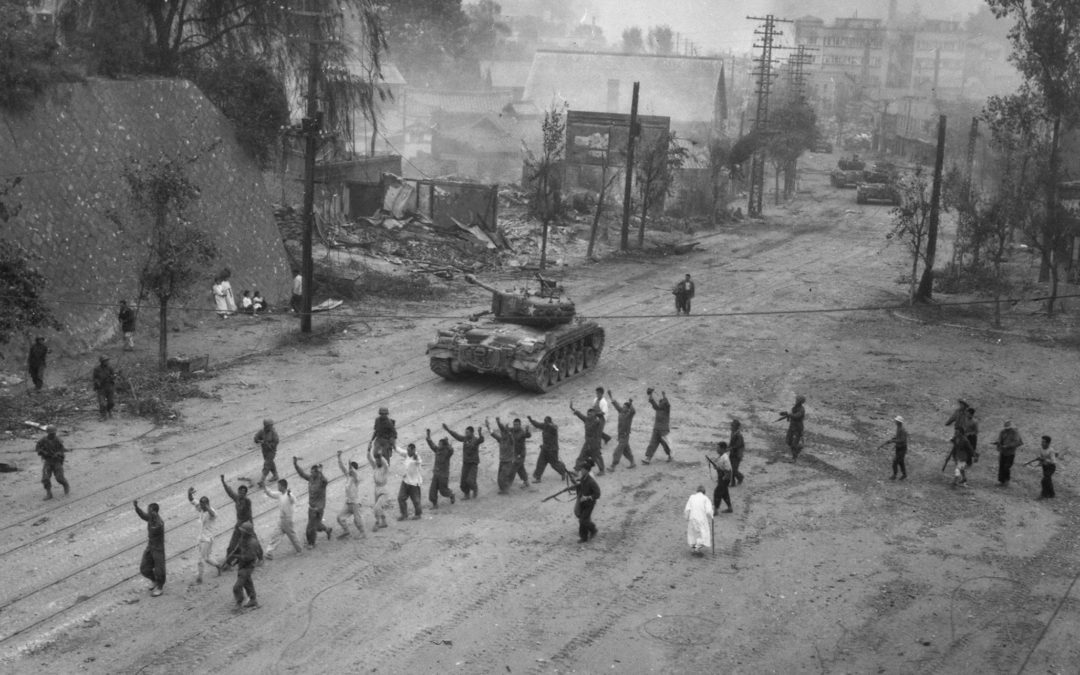
Recent chatter about David Remnick's interview of Stephen Kotkin reminds me of another interview that Kotkin recorded in February. Kotkin draws an analogy between Putin's decision to invade Ukraine and Stalin's decision to give Kim Il-sung the "green light" to invade South Korea in 1950. The comparison not only highlights the dysfunctions of personalist regimes, but the (potential) effects of the Russo-Ukraine War on U.S. foreign policy. Back in January, Gregory Mitrovich published an excellent piece about that in The Washington Post. Though the Cold War had begun several years before the...
So the New York Times reported on Beverly Gage, a history professor at Yale University, resigning from her post as head of the Brady-Johnson Program in Grand Strategy because of donor pressure. There's a lot at stake in this. As an academic field, grand strategy has a reputation for being very conservative, and for advocating a didactic, great-man view of history. The Yale program has not only been the premier school for grand strategy, inspiring a few similar programs at similarly prestigious universities; it has also been the premier focal point for critics of grand strategy who see it as...
The United States is closing in on the 18th anniversary of its first wartime death in Afghanistan, that of CIA operative Mike Spann, providing a melancholy opportunity to emphasize the role of grand strategy as a policymaking tool. To this end, I ask why the United States has done relatively poorly in so many of its so-called small wars, wars against much weaker adversaries. Its poor record is surprising because the United States has done so well in its major wars, including the world wars, the Korean War, and the Cold War. Some of the United States’ smaller wars have gone as planned. The...
In late May, the People’s Republic of China (PRC) released a white paper on China’s Military Strategy. This public release is the first of its kind, and it has received relatively little attention in the broader media. While much of the strategy is of no big surprise (broad and sweeping claims to reunification of Taiwan with mainland China, China’s rights to territorial integrity, self-defense of “China’s reefs and islands,” a nod to “provocative actions” by some of its “offshore neighbors” (read Japan)), there was one part of the strategy that calls for a little more scrutiny:...
Naazneen Barma, one of the authors of the "Mythical Liberal Order," responded to my post of last week with a reply to my critique. With her permission, I'm posting her message here and my response. Readers, we'd love for you to weigh in with your views. Naazneen had this to say about my original post: I'd push back, in particular, on your straw man point. We started by defining the aspirations / ideal of the liberal order precisely because that's what so many turn to in defending it. Our goal was to separate the aspirations from the reality — and then to ask, very concretely, whether it is...