Even when Latin Americans are allowed to speak, IR scholars and practitioners do not listen to them due to the language in which they produce knowledge, epistemic violence and access barriers.
The volume calls on international-relations instructors to make use of “subversive pedagogies” — ones that embrace a more holistic understanding of teaching. It invites academics to interrogate what we teach, how we teach, where we teach, and whom we teach.
Two recent interviews in the New Yorker have received substantial attention in recent weeks. Unfortunately, taken together, they make the IR discipline look terrible. How can IR theorists demonstrate their discipline’s relevance in the face of rapidly changing historical events?
In December of 2020, the U.S. government announced that hackers – most likely from Russia’s military intelligence agency, the GRU – had compromised over two hundred companies and federal agencies....
This is a guest post from Paul Johnson, who is an operations research analyst with the US Army. His personal research ranges on topics from political violence and militias to security force loyalty and design. The views expressed here do not represent the perspective of the US Army or Department of Defense. Given this forum’s focus as an outlet helping bridge the gap, this post discusses ways that academics working on national security-related topics can make themselves and their work more accessible to potential end-users, as seen and experienced from the author’s perspective as a...
Last night, I taught another session of our Dissertation Proposal Workshop class, and the topic was the methodology section of one's proposal. That is, how am I going to research this question and how do I justify the choices I made? This is after going through the other pieces--the question, the proposed answer, what other folks have said about this or have said about other stuff that you want to bring to this project, the theory, and the hypotheses. How does one test the hypotheses was the question du jour (or nuit). Before I start, to be clear, no one should expect...
Steve Saideman’s recent Duck piece on international relations scholars’ relative silence on issues of pandemics, and public health more generally, has ruffled feathers[1]and generated a lot of discussion: about marginalization of certain research outlets and methodologies, about the value of interdisciplinary work in a self-identifying-as-such-but-still-not-all-that-interdisciplinary discipline, and about what it means to say “IR as a field has little to say” vs. “individual IR scholars having said quite a bit.” This all hits pretty close to home. As an IR scholar whose main area of...
The Covid-19 pandemic has led to many useful discussions about public health, social responsibility, and tips for online learning. See the many great posts that have gone up here. One thing that hasn't been discussed enough, in my opinion, is work-life balance. Given all the pressures of the modern University, how do we ensure the expansive demands of remote learning don't swamp us and--for those of us with families--undermine our commitments to our kids or an equitable marriage? I'll start with my situation. My wife has been home with our kids (2&4) and was actually planning on going...
* I have changed the title as I got plenty of pushback on twitter--that there is plenty of IR on Pandemics, not just in the major journals. And I will add an update at the bottom later to address the criticisms later. People are wondering why there has not been much scholarship on the international relations of pandemics in the mainstream journals. out of curiosity, looked at how many times the term “pandemic” has appeared in top IR journalsIO: 0APSR: 0JCR: 0WP: 0AJPS: 3EJIR: 6JPR: 8JOP: 8IS: 13ISQ: 17— Seva (@SevaUT) March 15, 2020 Not a scientific survey of the literature, but it gives you...
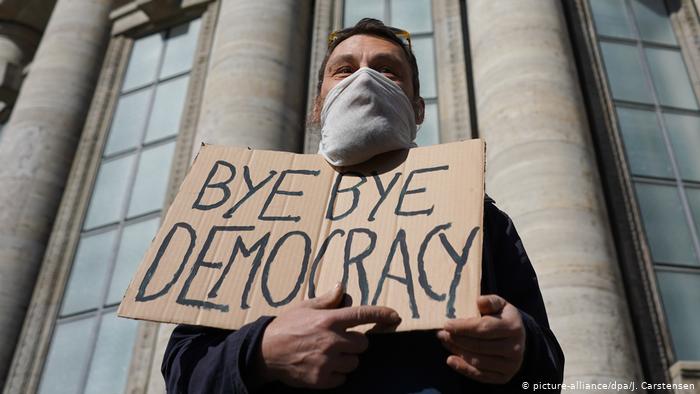
This is a guest post from Jeffrey C. Isaac and William Kindred Winecoff who both teach political science at Indiana University, Bloomington Last Wednesday the two of us circulated an open letter from U.S. political scientists, expressing concern about how the crisis surrounding the COVID pandemic could endanger the November election, and declaring that “We Must Urgently Work to Guarantee Free and Fair Democratic Elections in November” (posted at bottom). The letter endorsed the excellent report produced by legal scholars at the Brennan Center for Justice, entitled “Responding to the...
As the world rushes to respond to the Covid-19 pandemic, international relations scholars have a lot to say. We are not public health experts, or pathologists. But we can speak to the way states respond to common threats and the political process needed to formulate an effective response. One common reference is the realist idea of self-interest driving state behavior and undermining collective action. Yet, while realism as an inclination can explain what's going on, Realism as a scholarly theory cannot. Many scholars and general observers of international relations have reacted with...
Catherine Sanger talks about the challenges and opportunities of moving teaching online.