Academic debates about NATO-Russian relations are deeply entangled with policy preferences.
Now that Canada has decided to continue to train and support the Kurds in Iraq along with the Iraqi government, the question of the future of the Kurds is being questioned. Indeed, yesterday, I...
This is a guest post by Dan Nexon, Associate Professor in the Department of Government at Georgetown University and Stacie Goddard, Jane Bishop ’51 Associate Professor of Political Science of...
Inside Higher Ed must be having a slow news week.[1] Today, they are reporting on the APSA 2014-2015 Graduate Placement Survey as if it’s brand new. The report actually came out in early December. ...
That's essentially the question Steve Saideman asked here (and which he more explicitly asked on Twitter). His answer, which I find problematic, is But here is the big problem in all of this: perhaps much of IR is not about bargaining and persuasion about commitment and resolve. Perhaps much of IR is a conflict of interests, and that countries engage in conflict when their various interests cannot be resolved. He goes on to say The amateur game theorist might want to argue that this then is not chicken or prisoner's dilemma but deadlock. And they would probably be right--that much of what...
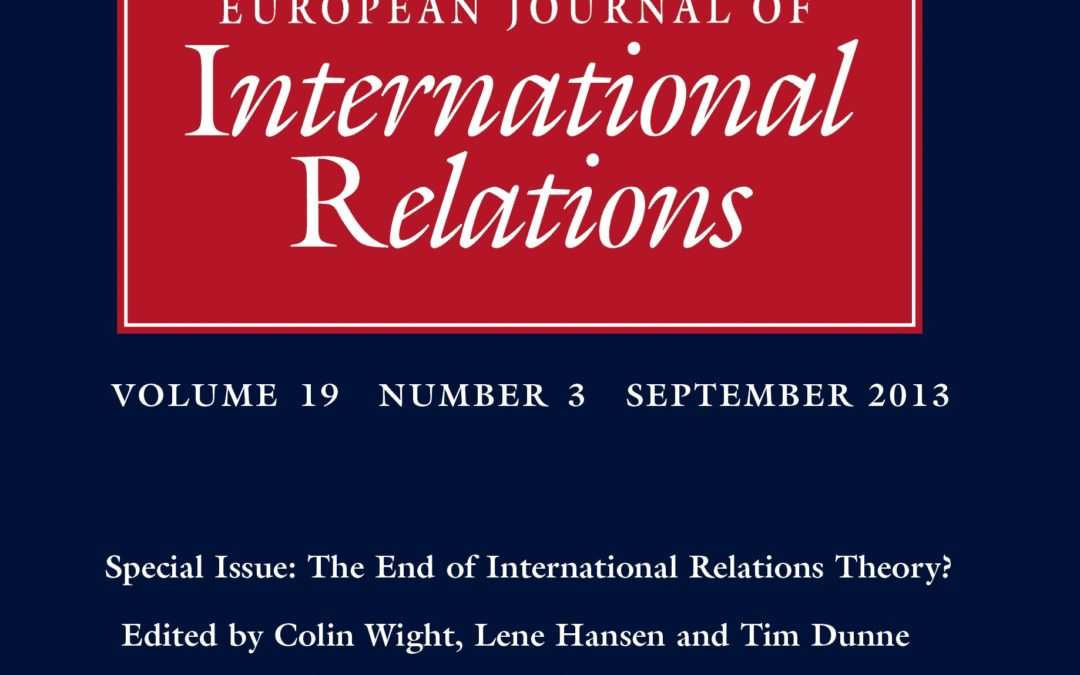
Editor's Note: This is a guest post by Milja Kurki. It is the 18th installment in our "End of IR Theory" companion symposium for the special issue of the European Journal of International Relations. SAGE has temporarily ungated all of the articles in that issue. This post refers to Reus-Smit's article (PDF). His post appeared earlier today. Other entries in the symposium--when available--may be reached via the "EJIR Special Issue Symposium" tag. Christian Reus-Smit’s latest intervention into the seemingly never-ending ‘meta-wars’ published in the long-awaited EJIR special issue on ‘end of...
Editor's Note: This is a guest post by Christian Reus-Smit. It is the 17th installment in our "End of IR Theory" companion symposium for the special issue of the European Journal of International Relations. SAGE has temporarily ungated all of the articles in that issue. This post refers to Reus-Smit's article (PDF). A response, authored by Milja Kurki, will appear at 11am Eastern. Other entries in the symposium--when available--may be reached via the "EJIR Special Issue Symposium" tag. Metatheory is out of fashion. If theory has a purpose, we are told, that purpose is the generation of...
It's late Friday afternoon -- here are a few things worth reading: Betcy Jose asks, with all of the attention on chemical weapons, why does it matter how people die in conflict? Sohail Hashmi and I agree we need stronger protection for civilians in conflict, but ignoring the use of chemical weapons is not the way to do it. David Petrasek is moderating and contributing to an excellent discussion of R2P and Syria at OpenGlobalRights. A go-to source for documents and links on Syria Trying to get to the bottom of this. There is a widening gap in reported regime casualties between the Syrian...
Over at the Woodrow Wilson Center's New Security Beat, I have a new post about a recent Science article by several economists on the connections between climate change and conflict. That article, which featured a reanalysis of sixty studies, sought to unambiguously demonstrate the climate effects contribute to conflict across a range of time periods, levels of conflict, and countries (see my previous Duck post with links to other critiques). However, as I suggested, the lack of serious attention to causal processes and the lumping together of quite distinct phenomena under a broad umbrella...
There is an ongoing debate questioning if and how reputation matters in International Relations. The question is important right now in relation to the red line the United States setup regarding the use of chemical weapons in Syria. I am not sure how reputation can matter if Russia is being held up as the mediator in striking a deal with Syria, Russia, and the West. If Russia is the mediator, the source of guarantees about respect for international law and the chemical weapons convention, reputation clearly does not matter because Russia has very little standing in terms of respecting...
Editor's Note: This is a guest post by Phil Arena. It is the 16th installment in our "End of IR Theory" companion symposium for the special issue of the European Journal of International Relations. SAGE has temporarily ungated all of the articles in that issue. This post refers to David A. Lake's article (PDF). His post appeared earlier today. Other entries in the symposium--when available--may be reached via the "EJIR Special Issue Symposium" tag. Lake's “Theory is dead, long live theory: The end of the Great Debates and the rise of eclecticism in International Relations” articulates well...
Editor's Note: This is a guest post by David A. Lake. It is the 15th installment in our "End of IR Theory" companion symposium for the special issue of the European Journal of International Relations. SAGE has temporarily ungated all of the articles in that issue. This post refers to Lake's article (PDF). A response, authored by Phil Arena, will appear at 10am Eastern. Other entries in the symposium--when available--may be reached via the "EJIR Special Issue Symposium" tag. The field of International Relations...