126 countries now publish a national security strategy or defense document, and 45 of these feature
a leaders’ preambles. How these talk about the world, or not, is surprisingly revealing of historical
global strategic hierarchies.
126 countries now publish a national security strategy or defense document, and 45 of these feature
a leaders’ preambles. How these talk about the world, or not, is surprisingly revealing of historical
global strategic hierarchies.
In 1932, John Chamberlain lamented “the unwillingness of the liberal to continue with analysis once the process of analysis had become uncomfortable.” He was critiquing the way...
When I first started teaching introduction to international relations, I included a lecture on the use of force in my foreign policy unit. We talked about Art's four uses of force, Schelling's...
Not many know that Trump was on the verge of publicly announcing U.S. withdrawal from the alliance at the 2018 summit. Congress would have prevented a formal end to U.S. membership, but Trump’s announcement itself would have caused irreparable damage. Why then did Trump change his position on NATO in 2019? And why was NATO, at least in military terms, in better state when Trump left office than when he began his term?
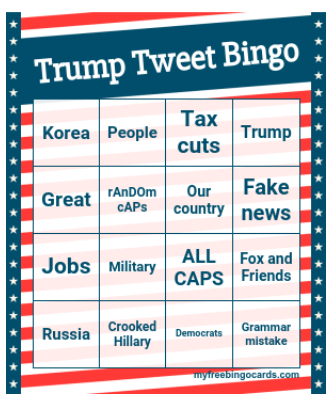
Following the Trump administration is really tiring. And I’m not talking about the last two years -- it’s a challenge to survive single weeks of their news cycle. Hell, a Friday afternoon is already taxing. That is why over here in Europe we’re very careful about checking headlines and Twitter Friday night. The outrage at the next fecal storm would keep you up better than a crying baby/ thoughts on the upcoming semester/deadline [insert your trigger]. The White House scandal diapering, however, is extremely predictable. No collusion, Hillary, fake news, Fox and friends, random capitalization...
This is a guest post from Eric Van Rythoven. Eric Van Rythoven recently finished his PhD at Carleton University studying emotion, world politics, and security. His work is published in Security Dialogue and European Journal of International Relations. There is a recurring frustration among observers of the Trump administration that commentary easily becomes distracted. Stories about the Trump family’s everyday nepotism and corruption may be important in the context of a so-called ‘normal’ presidency, but these are small marbles when compared to the administration’s catastrophic performance...
This post comes from Steve Weber, Professor at the I-School and Department of Political Science and Director of the Center for Long-Term Cybersecurity at the University of California, Berkeley, and a co-director of the Bridging the Gap project. It has become common in 2018 to hear that the United States and China are locking themselves into an Artificial Intelligence 'arms race'. While global politics will certainly change in the machine learning era, the supposed 'arms race' between the US and China may turn out to be less interesting and relevant in this world than the relationships...
For the first year of the Trump Administration, the Washington D.C.- based denizens of the U.S. foreign policy establishment assured themselves that although Donald Trump had tipped over the geopolitical apple cart, everything broken could be put back into place without undue difficulty. They were wrong. Taking their cue from the caustic reactions of American allies to Trump's twin summit debacles, foreign policy elites on both sides of the aisle are now a chastened bunch--only too aware of the immense damage Trump is doing to the fabric holding together America's alliances, the de jure and...
This post comes from James Goldgeier, professor of international relations at American University, Visiting Senior Fellow at the Council on Foreign Relations, and a co-director of the Bridging the Gap project. You can follow him on Twitter @JimGoldgeier. Earlier this month, we held our annual Bridging the Gap (BtG) International Policy Summer Institute (IPSI) for faculty and postdocs who want to be more publicly engaged and policy relevant. Scholars who want to pursue this type of work need to keep in mind a point Duke professor and BtG co-director Bruce Jentleson always makes: Faculty...
This post in the Bridging the Gap series come from Sara Plana and Rachel Tecott, doctoral candidates in the Department of Political Science at the Massachusetts Institute of Technology. (Sara is also an alumna of BtG's New Era Workshop.) They are the founders of the Future Strategy Forum and co-organized the Future of Force conference held in May 2018. Follow them on Twitter @saracplana and @racheltecott. Last month, the Center for Strategic and International Studies and the Kissinger Center at John Hopkins SAIS hosted a conference on the “Future of Force,” inaugurating a new series called...
This is a guest post by Sarah Detzner, a Ph.D Candidate at the Fletcher School of Law and Diplomacy. Her research is focused on international security, particularly post-conflict stabilization/reconstruction and security sector reform. In addition, she serves as Director of the Fletcher Graduate Writing Program, as a Fellow at the Center for Strategic Studies and the Institute for Human Security, and as a consultant for the World Peace Foundation. Previously, she served in the Obama Administration as a speechwriter for former Secretary of Defense Robert M. Gates, campaigned as an Obama 2008...
Earlier this week, a particularly volatile fissure within the Trump Administration opened up. Nikki Haley, the US Ambassador to the United Nations, announced on Sunday that the Administration would be imposing fresh sanctions on Russia. However, the Administration quickly denied that this was true, stating—in fact—that her statement was based on “momentary confusion.” Haley struck back saying that she does not “get confused.” This is not the first issue of unclear signals (see my previous post about this here), but it holds significance for how we approach signaling in foreign policy. In...