There is more continuity in the history of U.S. military basing policy than is typically assumed.

On Continuity in U.S. Military Basing Practices
read more
There is more continuity in the history of U.S. military basing policy than is typically assumed.
This is a guest post from Paul Johnson, who is an operations research analyst with the US Army. His personal research ranges on topics from political violence and militias to security force loyalty...

This is a guest post by Richard W. Maass, an Associate Professor at the University of Evansville. His research focuses on international security, US foreign policy, terrorism, and diplomatic...

As the world rushes to respond to the Covid-19 pandemic, international relations scholars have a lot to say. We are not public health experts, or pathologists. But we can speak to the way states...
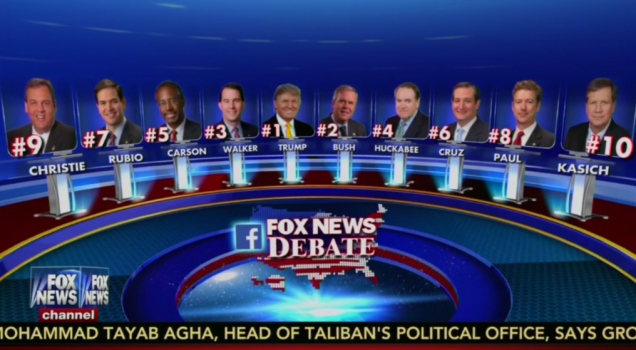
I will be live-tweeting the foreign policy dimensions of the GOP debate tonight here. Readers may want to chime in here on this open thread with the pre-, during, and post-debate reactions. It may be the silly season in the GOP primary, but with the Iran deal pending before Congress, these are consequential times. Yesterday, I live tweeted President Obama's address on Iran and will be synthesizing my observations on the deal and the politics surrounding it in coming days. Get your popcorn and laptop out tonight and stay tuned for the main attraction on your TV. BTW, as ever, I encourage...
As a new Duck, who (like Cai & Tom) took a while to consider what to blog about, I finally decided - long-winded academic that I am - to write a series of posts on the #BringBackOurGirls hashtag campaign. To this end, I draw on materials for a keynote I just delivered at the University of Surrey's Center for International Intervention's conference on "Narratives of Intervention: Perspectives from North and South" (#cii2015). Here I go: On April 14, 2014, 276 girls between the ages of 15-18 years were abducted from a school in Chibok, Northern Nigeria, days before they were set to take...
I woke up this morning to read (a few hours behind most of you...one of the few downsides to living in the Pacific Northwest is living behind the news cycle!) about the finalizing of a nuclear deal between the E3/EU+3 and Iran. I'll leave it to others to analyze whether the deal is a good one and whether it will indeed limit the ability of Iran to develop a nuclear weapon. Charles Krauthammer hates it. Joe Cirincione loves it. Jeffery Goldberg isn't quite sure what he thinks of it. My own thinking tends towards agreeing that the agreement isn't spectacular, but that it might be the least...
In late May, the People’s Republic of China (PRC) released a white paper on China’s Military Strategy. This public release is the first of its kind, and it has received relatively little attention in the broader media. While much of the strategy is of no big surprise (broad and sweeping claims to reunification of Taiwan with mainland China, China’s rights to territorial integrity, self-defense of “China’s reefs and islands,” a nod to “provocative actions” by some of its “offshore neighbors” (read Japan)), there was one part of the strategy that calls for a little more scrutiny:...
For the past two years, Jon Monten, Jordan Tama, and I have been working with the survey team at the Chicago Council on Global Affairs (Dina Smeltz and Craig Kafura) to revive the leader surveys that the Council used to run alongside their foreign policy opinion surveys of the American public. Because of the expense and the difficulties of getting responses, the Council discontinued those surveys in 2004, leaving academics with really limited options for comparing public and elite attitudes. With the release of a Council report and a recent piece ($, DM me for a PDF) in Foreign Affairs, we...

I have yet to weigh in on the recent hack on the Office of Personnel Management (OPM). Mostly this is due to two reasons. First is the obvious one for an academic: it is summer! But the second, well, that is due to the fact that as most cyber events go, this one continues to unfold. When we learned of the OPM hack earlier this month, the initial figures were 4 million records. That is, 4 million present and former government employees’ personal records were compromised. This week, we’ve learned that it is more like 18 million. While some argue that this hack is not something to be...

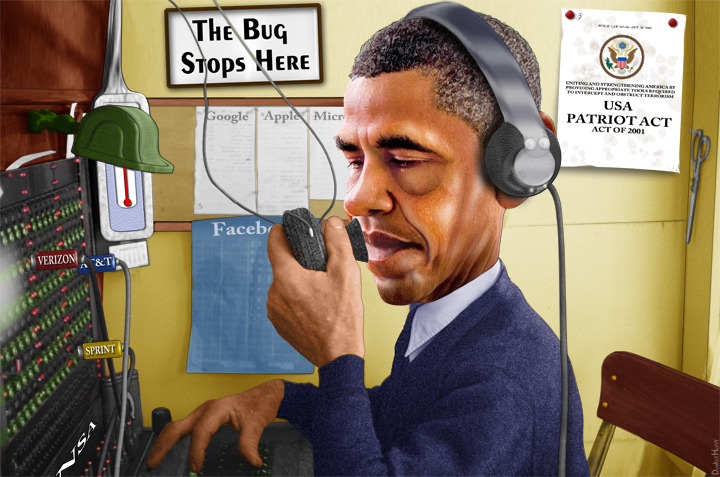
With much attention being given to the passage of the 2015 USA Freedom Act, there is some odd silence about what the bill actually contains. Pundits from every corner identify the demise of section 215 of the Patriot Act (the section that permits the government to acquire and obtain bulk telephony meta data). While the bill does in fact do this, now requiring a “specific selection term” to be utilized instead of bulk general trolling, and it hands over the holding of such data to the agents who hold it anyway (the private companies). Indeed, the new Freedom Act even “permits” amicus curiae...
The Department of Defense’s (DoD) new Cyber Strategy is a refinement of past attempts at codifying and understanding the “new terrain” of cybersecurity threats to the United States. While I actually applaud many of the acknowledgements in the new Strategy, I am still highly skeptical of the DoD’s ability to translate words to deeds. In particular, I am so because the entire Strategy is premised on the fact that the “DoD cannot defend every network and system against every kind of intrusion” because the “total network attack surface is too large to defend against all threats and too vast to...