Why did some states successfully avoid conquest by European empires? Logan Cochrane’s new, co-edited volume tackles this puzzle.
US Secretary of State Marco Rubio’s speech at the Munich Security Conference demonstrated he is a better diplomat than Vice President J.D. Vance, although that’s not much of a hurdle to clear. Where...
A century before Trump’s tariff threats, Joseph Chamberlain pitched the same idea: use duties as a “big revolver” to force rivals into “fair trade.” That history helps explain why “unfairness” rhetoric and coercive foreign policy keep returning when hegemonic powers decline.
I’ve been wanting to write this post for some time. But every week just brings more bad news. More terrible examples. In November last year, the Dutch government almost collapsed over...
Intra-elite, state-centric society is a strategic front, and ought to be defended and put to use in the continued development of a global and decolonial turn in IR.
The special issue’s concerns could easily be a passing ‘fad’ as the forces of the status quo bide their time. A focal point on race, necessary as it is, could elide class and material factors’ influence on world politics.
There is no shortage of knowledge produced in various traditions and diverse scholarly communities. There is no lack of theoretical traditions and political thought that come from non-Euro-American and mainstream canons. There is also no shortage in theoretical concepts and approaches to global politics that are not produced in Anglophone spaces. Rather, there is still in mainstream IR a major problem of literacy to access, integrate, and dialogue with this wealth of IR scholarship produced in and from the margins
Even when Latin Americans are allowed to speak, IR scholars and practitioners do not listen to them due to the language in which they produce knowledge, epistemic violence and access barriers.
Decolonial methods, and the bringing of attention to race in knowledge production is necessarily historical. It demands a close re-reading of archives, forgotten texts, and sometimes “canonical” works. As a result, through this special issue and the wider work the authors build upon, we now have a very different understanding of the historical entanglements of race and international affairs knowledge.
Now that the myth of “theory-practice gap” has been largely refuted what role might IR and journals like International Affairs play in crafting a “reparative praxis”?
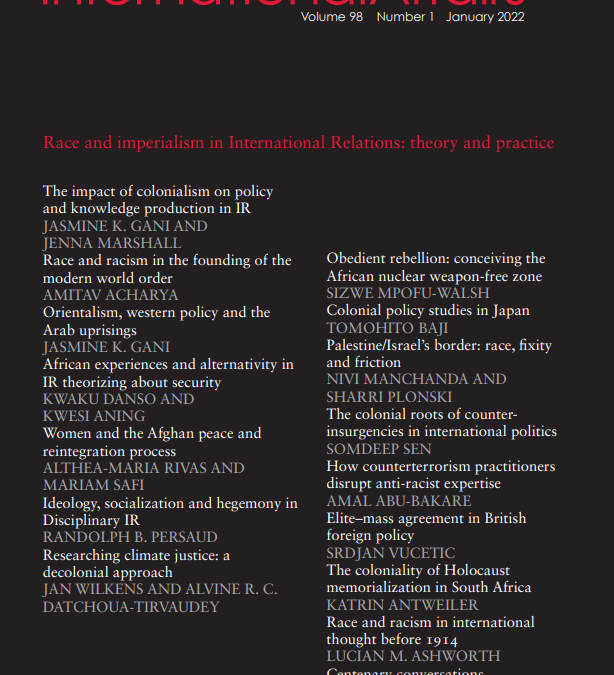
The International Affairs Centenary Special Issue on “Race and Imperialism in International Relations: Theory and Practice” was published two years ago in the aftermath of the global Black Lives Matter movement; it marked an atypical period of introspection by many scholars, departments, and journals of International Relations on the general paucity of attention given to matters of race and imperialism in IR research and teaching.
On February 21, the Federal Supreme Court of Iraq ruled on a set of cases pertaining to the Kurdistan Regional Government’s (KRG) electoral law. The Court declared that the 11 parliamentary reserved seats for minorities were unconstitutional. So too was the KRG’s single electoral district model....
Professor Lene Hansen of the University of Copenhagen likely needs no introduction to most listeners of this podcast. She has worked within what would be called the Copenhagen school or securitization theory, emphasizing within that school the overlooked lens of gender. Her work on discourse...
I recently submitted the below letter to Foreign Affairs in response to their latest issue's set of essays on Israel-Palestine peace. They decided not to run it, and I assume that's because of all the letters they get. However, I worry that we ignore the small-scale peace efforts that may be the...
Over the past few decades, Political Science has seen an increasing institutionalization of Scholarship on Teaching and Learning (SoTL) through journals, book series, and professional associations. Over at PS: Political Science and Politics, we add to this body of literature by making the case for...
The takeaway from last night's State of the Union address is that Biden's language continued decades-long trends of decreasing positive emotion, use of the term "we," and overall fewer words per sentence. Polarization data comes from V-Dem and the speeches were analyzed with LIWC. The State of the...