Does Whataboutism work? A new article has answers.
6+1 Questions about “The Diplomacy of Whataboutism”
read more
Does Whataboutism work? A new article has answers.
state takes precedence over their own lives. Focusing on states as persons distracts us from how violence travels across levels of analysis. States don’t do violence to one another. They inflict violence on actual living beings.
I have mixed feelings about Adam’s article. On the one hand, I think it does a very good job of outlining the realist metaphysical argument for treating states and other similar corporate actors as...

A state of mind is a contagious thingSpread it around you never know what the future brings…Marillion, “State of Mind” n his later writings, Ludwig Wittgenstein spends...
This is a guest post by Juergen Altmann and Frank Sauer. Juergen Altmann is a Researcher and Lecturer at Technische Universität Dortmund, a specialist in military technology and preventive arms control and among the first scholars to study the military uses of nanotechnology. Frank Sauer is...
An argument broke out about this question after the "Star Wars and International Security" panel at ISA this month. A few people on Twitter and PSRM (or so rumors have it) say dressing up renders pop culture research more marginal than it already is. I suppose a TRIP survey could more conclusively...
Last week, I asked a question online that was asked of me and then I asked at the ISA two weeks ago: Can you name women of color working in the US or Canada who do IR and are full professors? At the ISA, folks could only name one or two. On twitter and facebook and my blog since then, the total...
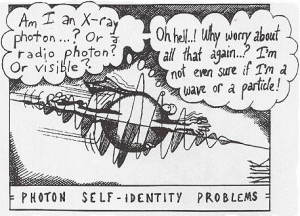
Tough as it is to follow Charli’s excellent post on terrorism, somebody has to do it and so I might as well. If this past ISA is any indication, quantum is a big deal. The panel on Alex Wendt’s new book linking quantum mechanics to the social sciences was standing room only (from what I hear, I...
I was among those last week, after hearing about the events in Brussels, who tweeted or Facebooked in solidarity with Belgium... but also in solidarity with civilians killed in Ankara, Baghdad, Yemen, later that week Cote d'Ivoire and (as of yesterday) in Lahore, Pakistan. I took some flak for...
The expectation that civilians should be protected from the worst excesses of war is traditionally viewed as a moral or legal restraint, moderating the kind of violence that can be inflicted on the battlefield. But the shift towards counterinsurgency in Afghanistan and Iraq and its emphasis on...

This is a guest post from Michael C. Horowitz (@mchorowitz), Associate Professor of Political Science and Associate Director of Perry World House, University of Pennsylvania Last week, Charli Carpenter published an important piece advancing the conversation about public attitudes, public...
Much of the present debate over autonomous weapons systems (AWS) focuses on their use in war. On one side, scholars argue that AWS will make war more inhumane (Asaro, 2012), that the decision to kill must be a human being’s choice (Sharkey, 2010), or that they will make war more likely because...
A couple of years ago, Human Rights Watch launched a report arguing for a treaty ban on fully autonomous weapons, claiming military robots who target and kill human beings would violate international law. Among other arguments, the report Losing Humanity cited the Marten’s Clause of the Hague...

Geologists now say that humans have had such an impact on the earth that we have entered in to a new age, what has been termed the Anthropocene. On some level, this is a political statement, but on another level, it could be an observable layer in the physical surface of the earth that future...
Some weeks ago, Stephen Walt lamented the absence of realist commentators in the American media space. What was striking to me at the time was Walt’s claim that realism is a ‘well-known approach to foreign policy.’ That claim—that realism is a foreign policy approach—makes sense in the context of...
Last December, on “Giving Tuesday,” I encouraged friends and family to send donations to three of my favorite charitable causes in lieu of birthday presents: low-income housing, domestic violence, and Syrian refugee relief. My son and I had signed up to compete that week in the Habitat for...